Nevada Gun Laws: Open Carry, CCW Permits, Background Checks, and More
Nevada Gun Laws: Open Carry, CCW Permits, Background Checks, and More
Nevada’s reputation as a gun-friendly state is well earned, but the reality is more nuanced than many residents and visitors realize. Between universal background checks, ghost gun restrictions, red flag laws, and location-specific bans, there’s a lot to understand before you carry, purchase, or transport a firearm in the Silver State. This guide breaks down every major area of nevada gun laws so you can stay on the right side of them.
Key Takeaways
-
Open carry is legal throughout Nevada for any adult over 18 who can lawfully possess a firearm-no permit required-but guns are still off limits in specific locations like public schools, most government buildings, and most Las Vegas casinos.
-
Concealed carry requires a concealed carry permit (CCW) issued on a shall-issue basis by the county sheriff; applicants must be at least 21, complete an approved firearm safety course, and pass a background check.
-
Background checks are required for most gun sales, including private sales, since Senate Bill 143 took effect in 2020, closing the prior private-party loophole.
-
Prohibited persons-including those with felony convictions, domestic violence offenders, people adjudicated as mentally ill, and individuals under restraining orders-are barred from possessing firearms under both state and federal law.
-
Nevada’s red flag law (ERPO) allows courts to temporarily remove firearms from high-risk individuals, and penalties for violating gun laws range from misdemeanors to category B felony charges with years of prison time.
Overview of Nevada Gun Laws
Nevada has a mix of moderate to strict gun laws. The state is broadly permissive when it comes to open carry and does not require registration of handguns or long guns. At the same time, it mandates background checks on nearly all firearm transfers, regulates ghost guns, and has enacted an Extreme Risk Protection Order law. The governing statutes are found primarily in the Nevada Revised Statutes (NRS) Chapter 202, supplemented by federal law such as the Gun Control Act and National Firearms Act.
Firearm registration is not required anywhere in the state. Clark County’s old “blue card” handgun registration requirement was abolished in 2015 by SB 175, so Nevada residents in Las Vegas and surrounding areas no longer need to register pistols. No state permit is required to purchase firearms in Nevada, though buyers must pass a background check through a licensed dealer.
The core distinction every gun owner should understand is this: open carry of a visible firearm is generally lawful without any permit, while carrying concealed requires a valid concealed firearm permit. Nevada law applies uniformly across the state-including major tourist destinations like Las Vegas, Reno, and Carson City-because the legislature reserves the power to regulate firearms through strong state preemption of local gun ordinances.
Nevada ranks moderately 17th in gun death rates as of 2024, reflecting both its permissive ownership culture and its growing body of regulations aimed at reducing gun violence. There are no state-mandated waiting periods for firearm purchases.
This article reflects law as of mid-2026. Always verify the most current statutes, case law, and agency guidance before making decisions about firearm possession or carry.

Where Firearms Are Prohibited in Nevada
Even though Nevada is an open carry state, firearms are banned or restricted in specific locations regardless of whether you’re carrying openly or with a valid ccw permit.
Key prohibited or restricted locations include:
|
Location |
Legal Basis |
Notes |
|---|---|---|
|
K–12 public and private schools |
NRS 202.265 |
Includes school property, parking lots, and events; written permission from principal required for exceptions |
|
Child care facilities |
NRS 202.265 |
Same rules as schools |
|
Secure areas of airports (e.g., Harry Reid International) |
Federal & state law |
Past TSA screening checkpoints |
|
Courthouses, legislative buildings |
NRS 202.3673 |
Buildings with metal detectors at every public entrance or posted signs |
|
Federal facilities (post offices, VA, federal courthouses) |
18 U.S.C. § 930 |
Federal law applies regardless of Nevada state law |
|
Military bases |
Federal regulations |
Governed by Department of Defense policy |
Firearms are prohibited in public schools in Nevada-carrying on school grounds without written permission is a criminal offense. Guns cannot be taken into government buildings like courts and jails, especially those with posted signage or metal detectors at every public entrance. Possessing a firearm in prohibited locations is a misdemeanor under Nevada law, though federal facilities can trigger federal criminal charges.
Private businesses can prohibit firearms on their premises through posted policies. Most Las Vegas casinos ban firearms, including open carry-security staff will ask armed guests to leave or check their weapons. Refusing to comply can result in criminal trespass charges (up to 6 months in jail and a $1,000 fine).
Firearms are allowed in hospitals unless prohibited by signage or specific policy. Places of worship, parks, and sports arenas may also allow firearms unless they post no-gun signs or are specifically covered by statute. Always look for posted rules before entering any building or certain locations where restrictions might apply.
Open Carry in Nevada
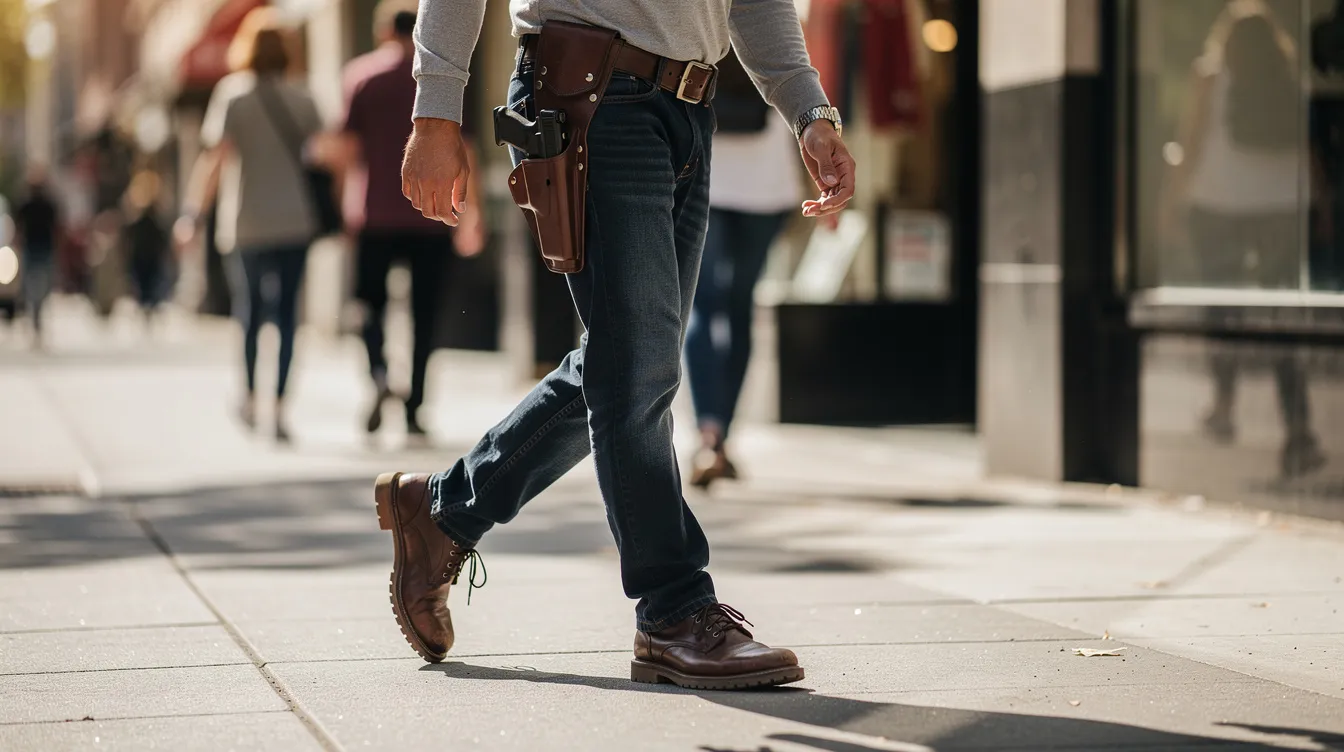
Open carry is legal throughout Nevada. Any adult over 18 can open carry a firearm-handgun or long gun-without any type of permit, making Nevada a true open carry state. Open carry is allowed in most public areas in Nevada, including sidewalks, parks, and most retail businesses that don’t post restrictions.
What “Open Carry” Means
The firearm must be visible to ordinary observation. A holstered pistol on a belt, a revolver in a visible hip holster, or a rifle slung across the shoulder all qualify. If the firearm is hidden under clothing, inside a bag, or otherwise concealed from view, it becomes a concealed weapon-and that requires a permit.
Minimum Age and Practical Access
The minimum age to possess a firearm in Nevada is 18 under nevada state law. However, individuals must be 21 years old to purchase a handgun from a licensed dealer under federal law, which limits practical access for 18- to 20-year-olds to private transfers or gifted handguns (still subject to background checks). Minors under 18 are generally prohibited from possessing firearms except for lawful hunting, target shooting, or safety training under adult supervision.
Vehicle Open Carry
In Nevada, a handgun may be openly carried in a vehicle without a permit. The rules differ for long guns: you cannot transport a loaded rifle or shotgun with a round in the firing chamber while in or on a vehicle under NRS 503.165. The loaded magazine may remain in the firearm, but the chamber itself must be empty.
Who Cannot Open Carry
People who are prohibited from possessing firearms-felons, certain domestic violence offenders, fugitives with an outstanding warrant, unlawful users of a controlled substance, those involuntarily admitted to a mental health facility, and certain non-citizens-commit serious felonies if caught with a gun, even if carried openly. Open carry does not override these disqualifications.
Concealed Carry and CCW Permits
Nevada is a shall-issue state for concealed carry permits. If an applicant meets all statutory requirements, the sheriff of the county must issue a concealed firearm permit-there is no subjective discretion beyond eligibility standards. Concealed carry permits are issued by local law enforcement agencies, typically the county sheriff’s office.
Eligibility Requirements
|
Requirement |
Details |
|---|---|
|
Minimum age |
21 years old (limited exceptions for active-duty military) |
|
Training |
8-hour certified firearm safety course with live-fire qualification |
|
Background check |
State and federal databases; a background check is required for concealed carry applicants |
|
Residency |
Nevada residents apply to their county sheriff; out-of-state applications go through nevada sheriffs in certain counties |
|
Disqualifiers |
Felony convictions, domestic violence convictions, recent DUIs, substance abuse issues, recent mental health commitments, current restraining orders |
Applicants must be over 21 years old for a CCW permit. They must demonstrate competence through a certified course and pass a thorough background check. Concealed carry permits are denied to applicants with recent mental health commitments or adjudications.
Permit holders’ names and addresses are kept confidential in Nevada-a privacy protection not all states offer.
Carrying concealed-meaning a concealed firearm hidden under clothing, in a purse, or otherwise out of view-without a valid permit is a Category C felony under NRS 202.350, punishable by 1 to 5 years in state prison and up to $10,000 in fines.
Reciprocity
Nevada honors out-of-state concealed carry permits only from states that meet specific training and background check standards. The Department of Public Safety updates this reciprocity list, typically by July 1 each year. If you hold a home state’s permit from a non-recognized state, carrying concealed in Nevada exposes you to felony criminal charges. Always verify whether Nevada recognizes your state permit before traveling with a concealed weapon.
Criminal Records and Other Disqualifications
Under NRS 202.360, certain people are prohibited from possessing any firearm in Nevada:
-
Individuals with felony convictions cannot possess firearms in Nevada
-
People convicted of domestic violence misdemeanors
-
Fugitives from justice
-
Unlawful users of a controlled substance
-
Nevada prohibits firearm possession for those adjudicated mentally ill
-
Certain categories of non-citizens
Penalty levels vary by disqualification:
-
Ex-felons, fugitives, or drug users in possession typically face a category b felony (1–6 years in prison, fines up to $5,000)
-
Persons prohibited solely due to mental illness or immigration status may face Category D felony charges (1–4 years)
Certain restraining orders or extended protection orders for domestic violence require immediate surrender of firearms and make future possession a separate crime. Record sealing under Nevada law does not by itself restore gun rights-a full pardon from the Nevada Board of Pardons Commissioners is generally required.
Restraining Orders and Extreme Risk Protection
Domestic violence protection orders and stalking or harassment orders can mandate that a person surrender all guns and ban them from purchasing or possessing firearms while the order is in effect. Violating firearm provisions in a restraining order can be charged as a gross misdemeanor or felony, depending on circumstances, with jail exposure and further loss of rights.
Nevada has enacted an Extreme Risk Protection Order law-commonly known as a red flag law-which took effect in 2019. Under this law, household members and any law enforcement agency can petition a court to temporarily remove firearms from an individual deemed at high risk of harming themselves or others. Nevada’s red flag law allows courts to remove firearms from dangerous individuals based on evidence of danger.
Two types of orders exist:
-
Emergency (ex parte) orders: Issued without the gun owner present, typically lasting up to 7 days, requiring immediate surrender of firearms
-
Extended orders: Lasting up to 1 year (renewable) after a full hearing where the subject can present evidence and contest the order
The subject of an ERPO can request a hearing to challenge the order and potentially regain their firearms if they no longer pose a significant danger. During the order’s duration, the person cannot purchase or acquire new firearms.
Common Firearm Crimes and Sentencing Enhancements
Beyond possession rules, Nevada law criminalizes specific ways of using, discharging, or trafficking firearms, often with serious felony penalties.
Crimes involving shooting firearms:
-
Wantonly or maliciously firing a gun from a vehicle or building into a populated area is typically a category B felony
-
Unsafe discharge of a firearm in unpopulated areas or into abandoned property is often a misdemeanor
Crimes involving aiming or brandishing:
-
Assault with a deadly weapon (pointing or firing a gun at someone) is a category B felony
-
Merely aiming a gun at another person can be a gross misdemeanor
-
Brandishing or drawing a gun in a threatening manner without justification can be a misdemeanor
Crimes involving making, selling, or distributing:
-
Unlawful sale or transfer to a prohibited person is generally a Category C felony
-
Possession or manufacture of short-barreled rifles or shotguns without proper federal registration is a Category D felony
-
Sale of metal-penetrating shotgun rounds can be charged as a gross misdemeanor
Serial number tampering:
-
Altering or removing a serial number is a Category C felony
-
Possessing a firearm with a defaced serial number is usually a Category D felony
-
Stealing a firearm is typically a category B felony under NRS 205.226
Sentencing Enhancements for Use of a Gun in a Crime
Nevada has firearm sentence enhancements under NRS 193.165: using or possessing a gun during the commission of many felonies can add up to 20 extra years to the underlying sentence. In some cases, this can roughly double the time served.
Enhancements do not apply when gun use is already an element of the crime itself. For example, assault with a deadly weapon already factors the firearm into the base offense.
Prosecutors in Clark County (Las Vegas) and Washoe County (Reno) frequently seek these enhancements in serious violent cases, including gang-related crimes and domestic violence incidents involving firearms. The court has discretion, but the practical effect is that committing any felony while armed dramatically increases potential prison time.
Background Checks and Private Gun Sales
Nevada requires background checks for all private firearm purchases, as well as all commercial sales through licensed dealers. This is part of broader efforts to prevent gun violence and keep firearms away from prohibited persons.
Current Framework
Senate Bill 143 mandated background checks for private gun sales in 2019. In 2020, Nevada enacted a law for background checks on private sales, making the requirement effective January 2, 2020. This law closed the prior “private sale” loophole by requiring that nearly all private firearm transfers go through a licensed dealer who runs a background check. Background checks are required for both commercial and private gun sales, with limited exceptions.
Nevada passed SB 143 to replace a 2016 voter initiative (Question 1) approved by nevada voters that was never implemented due to an FBI refusal to conduct checks on behalf of the state.
How it works in practice: If Alice wants to sell her rifle to Bob, they must go to a licensed firearms dealer. The dealer runs the same background check used for commercial sales. If Bob passes, the transfer proceeds. If Alice skips the dealer, she faces gross misdemeanor charges for a first offense and felony charges for repeat violations.
Exceptions
Limited exemptions exist under NRS 202.2541:
-
Temporary transfers for supervised use at a shooting range
-
Emergency transfers to prevent imminent harm
-
Transfers between certain immediate family members
-
Transfers for recreational use under direct supervision
What Triggers a Denial
Purchasers must complete ATF Form 4473, present valid identification, and pass a check through state and federal databases. Disqualifying records include felony convictions, domestic violence convictions, active restraining orders, mental health adjudications, and controlled substance use. Lying on forms or attempting straw purchases can lead to federal criminal charges.
There are no state-mandated waiting periods for firearm purchases in Nevada-once the background check clears, the transfer happens immediately.
Special Topics: Ghost Guns, NFA Weapons, and Assault-Style Firearms
Nevada law addresses several specialized categories of firearms and accessories that carry their own rules and penalties.
Ghost Guns
Nevada banned ghost guns in 2022 when Assembly Bill 286 took effect on January 1 of that year. Ghost guns lack serial numbers and are untraceable, making them a growing concern for law enforcement. AB 286 made untraceable weapons illegal in Nevada by prohibiting the possession, sale, and manufacture of most unserialized firearms and certain unfinished frames or receivers intended to become functional guns.
Nevada is one of 15 states regulating ghost guns. Penalties under AB 286 escalate: a first offense is a gross misdemeanor, while subsequent offenses are Category D felonies.
A judge nullified part of the ghost gun ban in 2023, finding portions of the law’s definitions potentially vague. However, the Nevada Supreme Court unanimously upheld AB 286 in April 2024, affirming that the ghost gun ban is constitutional. The supreme court rejected vagueness challenges and cleared the path for full enforcement.
Separate from state law, federal regulations now treat many key gun parts like complete firearms, requiring serial numbers and background checks. The U.S. Supreme Court has upheld much of this federal framework.
NFA Weapons
NFA weapons in Nevada-machine guns, short-barreled rifles and shotguns, silencers (suppressors), and certain destructive devices-are legal only if fully compliant with federal NFA rules:
-
Registered with the ATF
-
Tax stamps paid
-
For a machine gun, manufactured and registered before May 19, 1986
Possession of unregistered nfa weapons is a serious federal offense and often also violates nevada law under NRS 202.350, leading to potential federal prison time in addition to state charges.
Assault Weapons and Accessories
Nevada does not have a state-level ban on “assault weapons” as a separate category. Most semiautomatic firearms-including semi-automatic rifles and pistols-are treated the same as other firearms under state law. This is a key distinction for readers familiar with stricter laws in states like California or New York.
Fully automatic machine guns remain tightly controlled under federal law. Possession without proper federal paperwork is illegal regardless of Nevada’s lack of specific assault weapon statutes.
Nevada prohibits certain firearm accessories like bump stocks without serial numbers. The federal bump stock ban was invalidated by the U.S. Supreme Court in June 2024, and future legislative changes at the state level may follow. As with all areas of nevada gun law, monitor upcoming legislative sessions for nevada updates.
Special Rules for Minors, Alcohol, Hunting, and Transport
Nevada has tailored rules that differ from general open carry and concealed carry provisions in several important areas.
Minors and Minimum Age
Under NRS 202.300, persons under 18 generally may not possess firearms. Exceptions exist for supervised activities:
-
Lawful hunting with a valid license and adult supervision
-
Target shooting at a shooting range under adult supervision
-
Firearm safety training courses
Nevada enforces child access prevention laws for firearm storage-adults who leave firearms accessible to minors may face criminal charges. Aiding a child in unlawfully possessing a gun can be criminal: providing a firearm to a child when there is a substantial risk of violence is a Category C felony, while less risky first-time conduct may be charged as a misdemeanor.
Courts can impose penalties on juveniles for unlawful possession and suspend hunting privileges for at least two years for certain violations.
Alcohol and Firearms
It is not automatically illegal to carry a gun in a bar or while drinking in Nevada. However, having a blood alcohol concentration of 0.08% or higher while in possession of a firearm is a misdemeanor under NRS 202.257, regardless of location. This applies whether you’re in a bar, casino, private home, or public park.
Hunting
Hunters must hold a valid Nevada hunting license to use firearms in the field. Using guns for lawful hunting outside legal seasons, without proper tags, or in prohibited areas is a misdemeanor and can lead to fines, jail time, and long license suspensions. Compliance with season-specific weapon and caliber restrictions is mandatory.
Transporting Firearms in Vehicles and Travel Considerations
Vehicle transport rules at a glance:
|
Firearm Type |
Loaded? |
Chamber Status |
Permit Required? |
|---|---|---|---|
|
Handgun (visible) |
Yes |
Loaded OK |
No (open carry) |
|
Handgun (concealed) |
Yes |
Loaded OK |
Yes (valid CCW) |
|
Rifle/shotgun |
Loaded magazine OK |
Chamber must be empty |
No |
|
Any firearm (glove box/trunk/locked case) |
Unloaded |
Empty |
No |
Putting an unloaded firearm in a glove box, trunk, or hard sided case is generally lawful and does not require a concealed carry permit, as long as the gun is stored securely and the person can legally possess it.
Tourists and rental cars: Nevada law applies equally in personal and rental vehicles. Tourists may keep a loaded handgun in a rental car under open carry rules, but carrying concealed inside the vehicle requires a Nevada-recognized CCW.
Air travel: To fly into or out of Harry Reid International Airport with a gun, the firearm must be unloaded, locked in a hard sided case, and checked with baggage. Passengers must declare firearms at the airline counter and never bring them through TSA checkpoints.
When crossing state lines, drivers must comply with each state’s laws. The federal Firearms Owners Protection Act can provide limited safe-passage protections if the gun is unloaded and locked away while merely traveling through states with stricter regulations.

Tourists, Las Vegas Casinos, and Local Preemption
Many questions about nevada gun laws focus on Las Vegas, casinos, hotels, and tourist activities. Here’s what visitors need to know.
Open Carry for Tourists
Tourists can open carry firearms in Nevada without a permit-the same rules apply to visitors as to nevada residents. Non-residents over 18 who can lawfully possess firearms may openly carry in most public spaces, subject to all place-specific bans and federal rules. Open carry is prohibited in certain locations like casinos, regardless of who is carrying.
Concealed Carry for Visitors
Out-of-state concealed carry permits are valid only if Nevada honors that state under its reciprocity statute. The Department of Public Safety publishes the current list of recognized states. Carrying concealed with a non-recognized state permit exposes the visitor to Category C felony charges-the same as carrying without any permit at all.
Casinos, Hotels, and Private Property
Most Las Vegas casinos ban firearms, including open carry. These establishments are private property, and their security teams have authority to ask guests to leave or check weapons with security. Refusal to comply can result in law enforcement being called and criminal trespass arrests.
Many private businesses along the Las Vegas Strip and in downtown areas follow similar policies. Always check each property’s firearm policy before entering.
State Preemption
Local jurisdictions in Nevada cannot pass gun regulations stricter than state law. This preemption, strengthened by SB 175 and SB 240, means that local authorities in cities like Las Vegas, Reno, and Henderson cannot create their own firearm permit requirements, registration systems, or possession rules. They may regulate the discharge of firearms within city limits and set some local safety rules for shooting ranges, but nothing beyond what state law allows.
Purchasing Guns as a Visitor
Non-resident tourists can buy firearms from Nevada dealers, but federal interstate transfer rules apply:
-
Handguns must typically be shipped to a Federal Firearms Licensee (FFL) in the buyer’s home state for final transfer and background check
-
Long guns may sometimes be purchased and taken immediately if the transaction complies with the laws of both Nevada and the buyer’s home state, though many dealers prefer to ship to an in-state FFL for clarity
-
All purchases require completed ATF paperwork and background checks
-
Straw purchases or false statements can lead to federal charges, even for tourists visiting briefly

Restoring Gun Rights and Legal Help
Once a person loses their Nevada gun rights due to a felony conviction, domestic violence offense, or certain court orders, regaining those rights is difficult and highly regulated.
Record sealing under nevada law does not automatically restore firearm rights. Instead, individuals typically must obtain a full pardon from the Nevada Board of Pardons Commissioners to legally possess guns again. The general waiting periods to apply for a pardon differ by offense class-roughly 5 to 10 years after completion of sentence, parole, or probation, depending on the severity of the original crime.
Attempting to possess a firearm before rights are properly restored can result in new felony charges under NRS 202.360, with significant prison exposure.
Anyone facing firearm charges, under investigation, or seeking rights restoration should consult an experienced Nevada criminal defense attorney who regularly handles gun law issues-particularly in Clark County and Washoe County courts, where the majority of firearms cases are prosecuted.
Organizations like the Giffords Law Center and reporting from the Las Vegas Review Journal can provide additional context on evolving legislative efforts to prevent gun violence in Nevada. The right to bear arms is protected, but the legal framework around it is complex and constantly evolving.
FAQ About Nevada Gun Laws
Can I carry a gun while drinking or in a bar in Nevada?
Simply bringing a gun into a bar or restaurant that serves alcohol is not automatically illegal under Nevada law, unless the venue has posted no-firearm signs or is otherwise a prohibited location. However, it is a misdemeanor to have a blood alcohol concentration of 0.08% or higher while in possession of a firearm, regardless of whether you are in a bar, casino, private home, or public place. Combining firearms and alcohol is risky-intoxicated gun possession can lead to arrest, fines, jail time, and possible loss of gun rights.
Do I have to register my gun in Nevada or get a firearm owner’s license?
Nevada does not require statewide firearm registration for handguns or long guns, and there is no general gun owner licensing system. Clark County’s old “blue card” handgun registration system was abolished in 2015 by SB 175, so residents of Las Vegas no longer need to register their pistols. Although registration is not required, background checks are mandatory for most sales, and some special weapons (like NFA items) must be registered federally. No state permit is required to purchase firearms.
Is open carry allowed in Las Vegas casinos and on the Strip?
While Nevada law allows open carry in most public places, casinos, hotels, malls, and many other businesses along the Las Vegas Strip are private property and commonly ban both open and concealed carry. Casino security can ask armed guests to leave or disarm, and refusing to comply can result in law enforcement being called and possible trespass charges. Check each property’s firearm policy in advance and avoid carrying guns into casinos if there is any doubt about the rules.
Can my 17-year-old legally use a gun for hunting or at a shooting range?
Minors under 18 can lawfully use firearms in Nevada for hunting, target shooting, and training when supervised by a parent, guardian, or responsible adult, and when complying with all hunting and safety laws. Unsupervised possession or carrying by a minor can lead to juvenile court involvement and penalties, including potential loss of hunting privileges for at least two years. Parents should ensure minors complete a hunter education or firearm safety course and strictly supervise all use.
What should I do if I’m stopped by police while carrying a gun in Nevada?
Nevada does not have a universal “duty to inform” law, but it is generally wise to calmly tell the officer that you are lawfully armed, especially if you are carrying concealed with a valid permit. Keep your hands visible, follow all commands, and avoid sudden movements. If asked, present your CCW permit and identification. If you believe your rights were violated during a stop or gun seizure, document the incident and consult a Nevada attorney promptly. Cooperation and calm communication are the best approaches during any encounter with law enforcement.
Meta tags
Title
Navigating Nevada Gun Laws: Key Facts Every Gun Owner Should Know
65/70
description
Stay informed about Nevada gun laws with essential facts every gun owner should know. Read the article for clear guidance and important updates.
144/156