Minnesota Gun Laws: 2026 Guide to Carry, Ownership, and Recent Changes
Minnesota Gun Laws: 2026 Guide to Carry, Ownership, and Recent Changes
Minnesota has some of the more detailed firearm regulations in the country, layering state statutes on top of federal requirements in ways that affect everyone from first-time buyers to lifelong hunters. Whether you’re applying for a carry permit, purchasing a handgun at a gun show, or simply trying to understand what the latest legislative session changed, this guide breaks down what you need to know about minnesota gun laws as of mid-2026.
Key Takeaways
-
Minnesota is a shall issue state for carry permits. If you meet the statutory requirements, the county sheriff must issue a permit to carry (PTC), which covers both open carry and concealed carry of handguns.
-
A carry permit is required to carry a handgun in any public place. Long guns face separate transport and hunting rules, including requirements to keep them unloaded and cased in vehicles.
-
Background checks are required for most gun sales, including private transfers of handguns and certain semi-automatic firearms. Minnesota has recently expanded these requirements.
-
Recent changes taking effect in 2024–2025 include an extreme risk law (effective January 1, 2024), a ban on binary triggers (effective January 1, 2025, though currently under legal challenge), and new felony penalties for straw purchases.
-
Domestic abusers, convicted felons, and other prohibited persons face strict laws blocking access to firearms. Violations can quickly escalate into serious criminal charges, including fines and jail time.
Overview of Minnesota Gun Laws
Minnesota gun laws are primarily codified in Minnesota Statutes Chapter 624, with related provisions scattered across criminal law chapters and hunting regulations. The framework has been updated several times through 2026, and staying current matters.
The centerpiece is the Minnesota Citizens’ Personal Protection Act under Minn. Stat. § 624.714, which governs the permit to carry system for pistols. This single state permit covers both concealed carry and open carry in most public places. Minnesota has strict gun laws focused on permit requirements and background checks, and the system is designed so that a permit is required for nearly all public carry of handguns.
Minnesota is a shall issue state: the county sheriff must issue a carry permit if an applicant satisfies statutory criteria. There is no discretionary denial-if you qualify, the permit is yours. As of 2025, the state had approximately 375,551 valid carry permits, with nearly 66,000 new permits issued in that year alone, the highest level since 2021.
Handgun rules differ substantially from the regulations governing long guns like rifles and shotguns. Transport rules, hunting exceptions, and definitions of what counts as a “public place” all create separate tracks that gun owners need to understand.
Federal law intersects at several points. Licensed dealers must run NICS background checks on every sale, and federal prohibited-persons categories overlay state law. Sometimes these align neatly; sometimes they create confusion-particularly around issues like domestic violence convictions, where a state prohibition may be temporary but a federal ban may be permanent.
Permit to Carry: Concealed Carry and Open Carry Rules
Minnesota uses one permit-the Permit to Carry a Pistol (PTC)-for both concealed carry and open carry in public. There is no separate license for either method of carry. If you have a valid PTC, you may carry your handgun openly on your hip or concealed under clothing, subject to location restrictions.
Here are the core eligibility requirements:
-
Age: At least 21 years old under the statute. However, recent legislation allows individuals 18 and older to apply for a Permit to Carry, following the federal court decision in Worth v. Jacobson that struck down the under-21 ban. Implementation varies by county sheriff office.
-
Residency: Any minnesota resident may apply through their county sheriff’s office. Nonresidents may apply at any Minnesota sheriff’s office. Permits are issued through the county sheriff’s office.
-
Not a prohibited person: Applicants cannot have disqualifying convictions, active restraining orders, or mental-health-related prohibitions under state law or federal law.
-
Training: Applicants must complete a safety course covering the safe use of a pistol, including live-fire qualification and legal instruction, within one year of applying.
-
Background check: Background checks are required for permit applicants, covering state criminal records, NICS, and mental health records.
Key disqualifiers that will deny your application include:
-
Felony “crimes of violence” (lifetime ban unless rights restored)
-
Certain domestic violence offenses (temporary or permanent bans)
-
Active protection orders or extreme risk protection orders
-
Recent controlled-substance crimes
-
Court-ordered mental health commitments
Carrying a handgun in public without a valid carry permit is generally illegal, whether the firearm is concealed or openly carried. Exceptions are narrow: inside your home, your place of business, or on your own property.
Permit fees vary by county but are capped by statute. Sheriffs have a 30-day processing deadline. Minnesota carry permits are valid for five years, with renewal requiring updated training and a new background check.
Concealed Carry in Minnesota
Concealed carry means a handgun is hidden from ordinary view-under clothing, in a bag, or otherwise not visible to people around you. Concealed carry also requires a valid permit in Minnesota. There is no permitless concealed carry option in 2026, despite periodic pushes for constitutional carry legislation.
With a valid PTC, you may carry concealed in most public places. However, carry is prohibited by statute or policy in several categories of locations (covered in detail below), including schools, courthouses, secure airport areas, and posted private property.
Practical responsibilities for concealed carriers include:
-
Always carry your permit and a government-issued ID
-
Disclose your carry status to law enforcement when asked or during traffic stops
-
Understand Minnesota’s self-defense laws, including the duty-to-retreat doctrine that applies in many situations outside the home
-
Know that Minnesota does not have a “stand your ground” law in public spaces
Open Carry in Minnesota
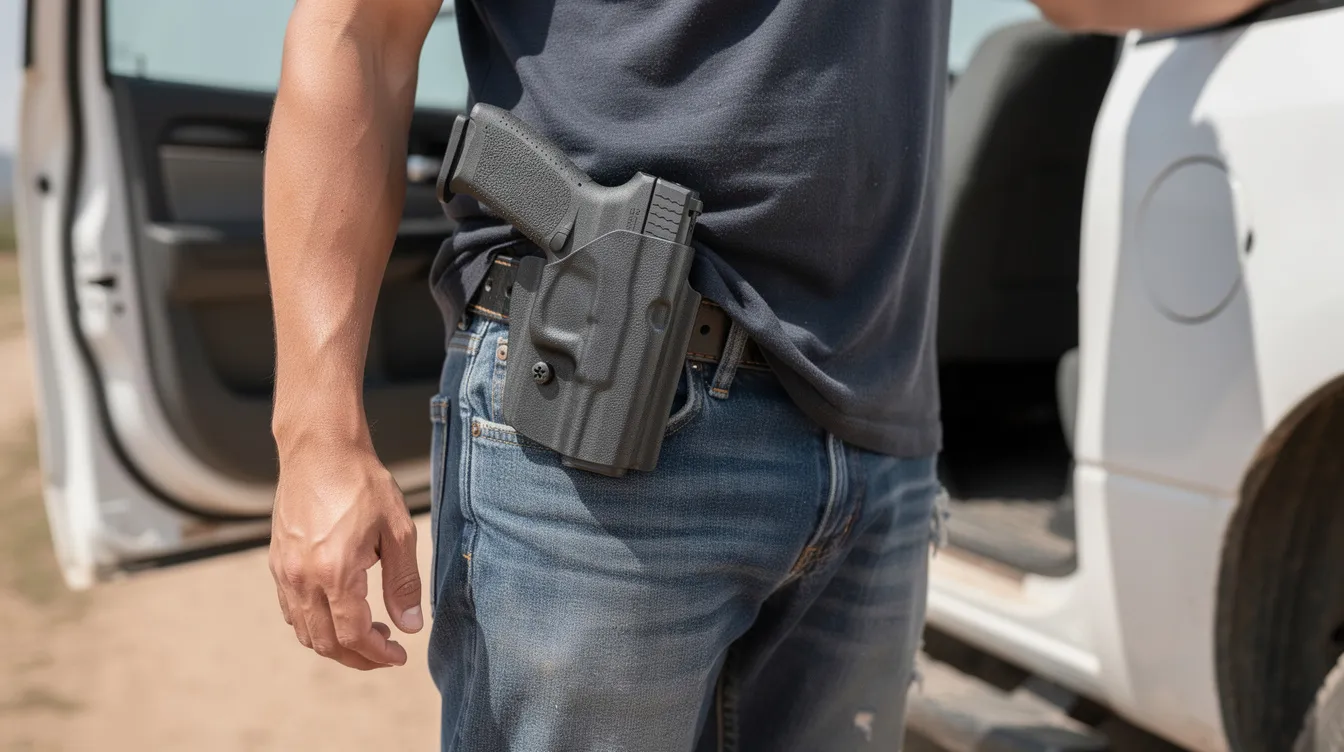
Open carry of a pistol is legal with a valid carry permit in Minnesota. Open carry is allowed in plain sight with a permit-think holstered handgun visible on the hip or in a chest rig. The same location restrictions that apply to concealed carry apply to open carry.
Open carry requires a valid permit in Minnesota. Open carry without a permit is illegal in Minnesota, limited only to your own home, land, or place of business. Carrying openly in a public place without a permit can result in criminal charges.
Behavior matters: even with a permit, brandishing or displaying a firearm in a threatening or disorderly manner can lead to charges. The goal of open carry laws is to allow the lawful bearing of arms, not to intimidate.
Local ordinances generally cannot override the state permit law. However, certain public buildings and posted properties can impose additional restrictions, and violating those postings can result in trespass or weapons charges.
Carrying in Vehicles, Boats, and Snowmobiles
With a valid carry permit, a person may carry a loaded, uncased handgun concealed or openly in a motor vehicle, boat, or snowmobile, subject to restricted-location rules. The permit essentially travels with you.
Without a carry permit, the rules tighten significantly. Handguns in motor vehicles must be unloaded and secured unless a Carry Permit is held. Under Minn. Stat. § 97B.045, firearms must be unloaded and in a closed, fastened case or stored in the trunk. The same applies to transport in boats and snowmobiles for unpermitted individuals.
During law enforcement traffic stops, calm communication is essential. If you hold a PTC, inform the officer. Understand that officers may conduct a weapons frisk based on probable cause or reasonable suspicion. Do not reach for the firearm, and follow all instructions. If you believe your rights were violated during a search, address it later with legal counsel-not at the roadside.
Where You Can and Cannot Carry: Location-Based Restrictions
Even with a valid carry permit, minnesota gun owners face strict no-carry zones. Carrying in restricted places can lead to gun charges ranging from misdemeanor to felony depending on circumstances.
Here are the main statutorily prohibited locations:
|
Location |
Carry Prohibited? |
Notes |
|---|---|---|
|
K–12 schools and school buses |
Yes |
Carrying is prohibited in schools in Minnesota |
|
Child-care centers |
Yes |
Minnesota enforces Child Access Prevention laws to prevent children from accessing firearms |
|
Courthouses and courtrooms |
Yes |
Certain locations within court complexes |
|
Federal buildings |
Yes |
Firearms are banned in government buildings in Minnesota |
|
Secure airport areas |
Yes |
Past TSA checkpoints |
|
Posted government buildings |
Yes |
Where signs or policy prohibit |
Private property: Businesses and property owners may bar firearms via signs or direct notice. Carrying is not allowed on private property with prohibitive signs. Refusal to leave after being informed can lead to trespass and weapons charges.
Establishments serving alcohol: Carrying firearms is prohibited in establishments serving alcohol. Additionally, carrying while intoxicated or with a blood alcohol concentration above legal limits triggers serious criminal liability regardless of location.
Places of worship, colleges, and public events: Institutional policies can differ from criminal statutes. A university may ban firearms under its code of conduct even if state law doesn’t specifically prohibit carry there. Gun owners should check individual policies before carrying at certain locations.
Rifles, Shotguns, and Other Long Guns in Public
Minnesota treats long guns differently from pistols. Open carry of rifles is generally prohibited in public places. In vehicles, long guns must typically be unloaded and cased.
Exceptions exist for lawful hunting, target shooting, and traveling directly to and from those activities. During these activities, hunters may transport a rifle or shotguns with ammunition nearby, but the firearm generally must not have a round chambered while in a vehicle unless the vehicle is stationary and specific conditions are met.
Local ordinances in dense urban areas like Minneapolis and St. Paul may further restrict the casual display or carry of long guns. Always check local rules in addition to state law.
Purchasing and Transferring Firearms in Minnesota
Gun sales in Minnesota are regulated by both federal law (through licensed dealers) and Minnesota statute (covering private sales, transfers, and record-keeping). The system is designed so that most purchases involve a background check at some stage.
For handguns and certain semi-automatic firearms, a Permit to Purchase or Permit to Carry is needed to buy firearms from dealers. The Permit to Purchase is specifically required to buy handguns and semiautomatic military-style assault weapons. Either permit involves a background check and signals to the dealer that the buyer has been vetted.
Private sellers now face expanded obligations. As of 2024, private transfers of handguns and certain long guns require compliance with transfer reporting requirements. Private sellers face gross misdemeanor charges for illegal transfers, making it critical to follow the process.
At gun shows, federally licensed dealers must run NICS background checks on every sale-there is no “gun show loophole” for dealer transactions. Minnesota’s private-transfer rules apply equally whether the sale happens at a kitchen table, a parking lot, or a gun show. Any minnesota resident buying firearms should verify current requirements before completing a transfer.
If a background check is delayed or denied, the buyer may appeal through administrative or court processes. Delays do not automatically result in denial; they simply mean the system needs more time to verify eligibility.
Background Checks and Prohibited Persons
The standard background check process in Minnesota involves a review of state criminal records, the federal NICS database, and mental-health-related disqualification reports. The Bureau of Criminal Apprehension plays a central role in processing these checks at the state level.
Typical categories of prohibited persons under Minnesota and federal law include:
-
Convicted felons (crimes of violence result in lifetime prohibition)
-
Individuals convicted of certain domestic abuse offenses
-
Persons subject to qualifying protection orders or restraining orders
-
Those adjudicated mentally ill or committed for chemical dependency
-
Persons convicted of a gross misdemeanor involving domestic assault, stalking, or bias-motivated crime (three-year state prohibition)
Certain felony convictions and domestic abuse convictions prohibit firearm possession-sometimes permanently under federal law even when the state prohibition has a defined end date. This mismatch between state and federal timelines is a frequent source of confusion and legal risk.
Attempting to purchase when prohibited is itself a crime. Always verify eligibility before any transfer, whether you’re the buyer or the seller.
Semi-Automatic Firearms, Accessories, and Recent Restrictions
Minnesota has not enacted a full assault-weapons ban as of mid-2026 but has added targeted restrictions on certain accessories and purchase methods.
Binary trigger ban: Effective January 1, 2025, minnesota law prohibits firearms equipped with a binary trigger-a device that fires one round on trigger pull and another on trigger release. The legislature defined these as “trigger activators” and banned their possession. However, in August 2025, a district court struck the ban on the grounds that the omnibus bill violated Minnesota’s single-subject constitutional requirement. As of early 2026, the matter is before the Court of Appeals, and a reenactment bill (HF 4359 / SF 4067) has been proposed. The legal status of binary triggers remains in flux, and owners should monitor news closely.
Straw purchase penalties: As of August 1, 2024, making a straw purchase is a felony, punishable by up to two years in prison and a $10,000 fine. If the weapon is used in a felony within a year, penalties jump to five years and $20,000. This law was passed in response to high-profile incidents, including the 2024 Burnsville shooting, and represents recent success in passing gun safety policies aimed at keeping firearms out of the wrong hands.
Minnesota does not currently ban machine guns beyond federal restrictions, and short barreled shotguns remain regulated primarily under federal law (National Firearms Act). Large-capacity magazine restrictions have been discussed but not enacted as of mid-2026.
Extreme Risk Law, Domestic Abuse, and Other Disqualifiers
Minnesota has shifted toward stronger gun control mechanisms aimed at high-risk individuals, especially domestic abusers and people in crisis. This shift reflects a broader trend of passing gun safety policies designed to reduce firearm violence while preserving the second amendment rights of law-abiding citizens.
Extreme Risk Protection Orders
Minnesota’s extreme risk law-often called a “red flag” law-took effect on January 1, 2024. Extreme Risk Protection Orders allow temporary removal of firearms from dangerous individuals.
Here’s how it works:
-
Who can petition: Law enforcement officials, city or county attorneys, family members, household members, or legal guardians
-
Standard: The petitioner must show that the person poses a significant danger to themselves or others
-
Emergency orders: Last up to 14 days, issued without a full hearing when immediate danger exists
-
Long-term orders: Issued after a hearing, lasting between six months and one year
-
Consequences: The subject must surrender firearms and ammunition while the order is active. Violation is a criminal offense.
The subject receives notice and an opportunity for a hearing before a long-term order is issued.
Domestic Abuse and Related Prohibitions
Domestic abuse restrictions limit firearm possession for individuals under protective orders. Convictions for domestic assault, stalking, and related offenses trigger prohibitions that may be temporary under state law (often three years) but permanent under federal law.
Domestic-abuse no-contact orders and certain harassment restraining orders can bar a person from possessing, purchasing, or carrying firearms. When a court issues such an order, the person must surrender all firearms-typically to law enforcement or a licensed dealer-within a specified timeframe. Failing to comply creates additional criminal exposure.
Gun owners should understand that even a misdemeanor domestic violence conviction can result in a permanent federal firearms prohibition, regardless of what state law says about the duration.
Restoration of Rights
Individuals who have been permanently banned due to felony convictions or mental health commitments may petition a court to restore firearm rights under Minn. Stat. § 609.165. The court considers evidence of treatment, at least three years free from the disqualifying condition, and whether restoration is consistent with public safety.
However, federal law may still prohibit possession even after state rights are restored-particularly for domestic violence convictions. Consulting an attorney before assuming rights are restored is critical.
Gun owners must report lost or stolen firearms to law enforcement-a requirement that supports both investigation of crime and accountability.
Enforcement, Searches, and Probable Cause Issues
Lawful carry can still trigger police contact. Peace officers may conduct a weapons frisk during a stop if they have reasonable suspicion that the person is armed and dangerous, or they may search a vehicle based on probable cause.
Minnesota appellate cases like State v. Serbus define what constitutes a public place and affect when carrying in or near a vehicle counts as public carry. These definitions matter because carrying without a permit in a public place is a crime, while possessing a firearm on your own property generally is not.
If you’re stopped:
-
Remain calm and keep your hands visible
-
Inform the officer if you have a carry permit and are armed
-
Do not resist a search, even if you believe it’s unlawful
-
Seek legal counsel promptly if arrested or cited for a gun-related offense
Minnesota firearm offenses can lead to fines and jail time, and the consequences compound quickly if you have prior convictions or are in a restricted location.
Crossing State Lines and Reciprocity
Minnesota recognizes carry permits from other states with similar requirements. The Department of Public Safety reviews reciprocity annually, and the list of recognized states can change.
As of 2026, Minnesota recognizes permits from states including Alaska, California, Colorado (permits issued or renewed after August 1, 2024), Connecticut, Hawaii, Illinois, Michigan, and New York, among others. Only permits that meet or exceed Minnesota’s standards qualify. A state permit from a country or state with substantially lower requirements will not be honored.
Minnesota does not recognize all nonresident or permitless-carry states. If your home state has constitutional carry but doesn’t issue a formal permit, you cannot carry legally in Minnesota without obtaining a recognized permit.
When traveling out of state, gun owners must obey the firearm and carry laws of the destination state, which may differ significantly. Some states restrict open carry entirely, impose magazine limits, or have different vehicle transport rules.
For interstate transport through restrictive states, follow these federal safe-harbor guidelines:
-
Keep the firearm unloaded
-
Store it in a locked container separate from ammunition
-
Transport it in the trunk or a locked compartment not accessible from the passenger area
-
Do not stop longer than necessary in states where possession would otherwise be illegal
A permanent resident of Minnesota who holds a valid PTC should also check whether the destination state recognizes the Minnesota permit before carrying across state lines. Missteps can result in serious charges, even for otherwise law-abiding gun owners.
Responding to Gun Charges and Staying Compliant
Any gun charge in Minnesota-whether for carrying without a permit, possessing as a prohibited person, or violating location bans-carries potentially severe consequences. These can include jail time, substantial fines, and long-term loss of the right to bear arms.
If you are investigated, arrested, or charged with a firearm offense, contact a criminal defense attorney experienced with Minnesota gun laws immediately. Do not make statements to law enforcement beyond identifying yourself and asserting your right to counsel.
Practical compliance tips every gun owner should follow:
-
Keep your permit current: Renew before expiration; your renewal window opens 90 days before the date it expires
-
Know restricted locations: Review the prohibited-location list regularly, especially if you carry in unfamiliar areas
-
Verify eligibility before any purchase or transfer: Check both state and federal disqualifiers, particularly if you have any prior convictions or mental health history
-
Stay informed about legislative changes: Last year saw significant changes, and more may come in 2026 with pending bills like HF 4359
-
Secure your firearms: Minnesota enforces Child Access Prevention laws to prevent children from accessing firearms; safe storage is both a legal responsibility and a moral one
-
Invest in training: Seek formal instruction that covers not just marksmanship but also Minnesota-specific legal responsibilities and the safe use of firearms in self-defense scenarios
Minnesota maintains a relatively low firearm violence rate compared to the national average in an average year, and its gun death rate remains below the country’s average. That low firearm violence rate is partly a function of the state’s regulatory framework-but only if gun owners actually comply with it.
The best way to protect your second amendment rights is to exercise them responsibly and stay on the right side of the law.
A bb gun or pellet gun, while not a firearm under most definitions, can still create legal complications in certain situations-particularly in schools or government buildings. Treat all weapons-related rules seriously.

FAQ: Minnesota Gun Laws
Is open carry legal in Minnesota in 2026?
Yes. Open carry of a handgun is legal in Minnesota in 2026 if the person has a valid Permit to Carry and is not in a restricted location such as a school, courthouse, or posted private property. Open carry without a permit is generally limited to your own home, land, or place of business. Carrying openly in a public place without a permit can result in criminal charges.
Do I need a permit to own a gun in Minnesota, or only to carry one?
Ownership and possession of firearms in your home generally do not require a carry permit. However, purchasing handguns and semiautomatic military-style assault weapons usually requires either a Permit to Purchase or a Permit to Carry plus a background check. A permit is mandatory for carrying a pistol in public, whether concealed or openly carried, and separate rules govern the transport and use of long guns.
Can I buy a gun at a Minnesota gun show without a background check?
Federal law requires licensed dealers to run background checks on all sales, including those at gun shows. Minnesota law also imposes requirements on private sales and transfers. Recent Minnesota reforms have tightened private-sale rules, so buyers and sellers should not assume any “gun show loophole” exists. Verify current requirements with the seller and, if needed, through the Minnesota Courts firearms information page before completing any transfer.
How does Minnesota’s extreme risk law affect gun owners who are reported by family members?
Under the extreme risk law, a court can issue an order temporarily prohibiting a person from possessing or purchasing firearms if evidence shows they pose a significant danger to themselves or others. The person subject to the order receives notice and an opportunity for a hearing. If the order is granted, they must surrender firearms and may face criminal penalties for possessing guns while the order is in effect. These orders are not permanent-emergency orders last 14 days, and longer-term orders last between six months and one year.
Are there special rules for hunters carrying long guns in Minnesota?
Hunters may carry long guns while actively hunting or traveling to and from lawful hunting areas, subject to seasons, licensing, and local safety ordinances. Long guns in vehicles typically must be unloaded and cased unless specific hunting-related exceptions apply under Minn. Stat. § 97B.045. Violating transport rules can result in citations or criminal charges, even for licensed hunters. If you’re heading to the field, make sure your firearm is unloaded and properly cased before you get in the vehicle, and only load when you’ve reached your hunting area.
Meta tags
title
Essential Guide to Minnesota Gun Laws for Responsible Ownership
63/70
description
Navigate Minnesota’s gun laws with confidence. This essential guide covers ownership responsibilities, regulations, and safety tips. Read more now!
147/156