Missouri Gun Laws: Concealed Carry, Open Carry, and Your Legal Responsibilities
Missouri Gun Laws: Concealed Carry, Open Carry, and Your Legal Responsibilities
Key Takeaways
-
Missouri is a constitutional carry state: most adults 19+ may carry concealed firearms or openly carry a handgun without a permit, while qualifying military members 18+ may carry under special rules.
-
Permitless carry became effective on January 1, 2017, but location-based restrictions still apply in schools, government buildings, polling places, secure airport areas, and some private property.
-
A missouri concealed carry permit, also called a ccw permit, is optional for in-state carry but useful for reciprocity in other states and for NICS-exempt firearm purchases.
-
Felons, some domestic violence offenders, fugitives, people under certain court orders, and unlawful users of a controlled substance may be prohibited under missouri law or federal law.
-
gun laws can change quickly, including rules on assault weapons, magazine limits, and restricted places. Verify current statutes and speak with a Missouri attorney for legal advice.
Overview of Missouri Gun Laws
Missouri is considered one of the more permissive states for gun ownership and carry. As of June 2026, Missouri law allows permitless carry for many adults, does not require a state firearm registry, and does not require a purchase permit for firearms. Still, federal law must be followed despite state autonomy regarding firearms, especially for background checks, prohibited persons, and federally regulated weapons.
Here is the basic distinction:
-
Possession means having legal possession of a firearm at home, in a vehicle, or on or her person.
-
Purchase means buying a firearm from a dealer or private seller.
-
open carry means carrying a firearm visibly, such as in a belt holster.
-
concealed carry means carrying a concealed weapon hidden from ordinary view.
-
Carrying with a concealed carry permit means you have a state-issued credential that may help with reciprocity and some purchase procedures.
Most Missouri firearms rules are in Chapter 571 of the Missouri Revised Statutes, especially weapons offenses and concealed carry provisions. You can review the current text through the Missouri Revisor of Statutes. Local ordinances may also regulate conduct such as unsafe discharge within city limits, but local governments are limited by Missouri’s preemption law.
This article is informational only and is not legal advice. If you are facing charges, have questions about gun violence allegations, or need guidance after a self defense incident, speak with a qualified Missouri criminal defense attorney.
Permitless Concealed Carry and Open Carry in Missouri
Missouri became a ‘Permitless Carry’ state on January 1, 2017. Since then, most adults who may lawfully possess a firearm can carry firearms openly or concealed without a state-issued permit. Missouri law allows individuals to carry firearms without a permit or background check for the act of carrying, although dealer purchases still require federal checks.
The general age rule is simple but important: you must be at least 19 to carry a firearm in Missouri, unless you qualify for a military exception. Members of the united states armed forces, active-duty armed forces, honorably discharged service members, national guard members, and some armed forces stationed in Missouri may qualify at 18. Separately, the minimum age to possess and transport a handgun is 18 years old.
In everyday terms:
-
open carry usually means a handgun is visible in a holster.
-
concealed carry means the handgun is hidden under clothing, in a bag, or otherwise not visible.
-
concealable firearms generally include handguns that can be carried on the body.
-
concealed firearms are still subject to restricted-place rules.
Missouri allows open carry of firearms without a permit, and many people may openly carry in public areas. However, local laws may restrict open carry despite state law in limited ways, especially when tied to specific government facilities, disorderly conduct, or discharge rules. A city may not simply use an ordinance prohibit lawful carry in a way that conflicts with state preemption, but local authorities may still enforce valid rules about dangerous conduct.
Even in a permitless carry state, prohibited persons cannot carry or possess guns. If such person is barred by state law or federal law, possession of a firearm may be a felony violation.
Who May and May Not Possess Firearms in Missouri
Missouri follows both state law and federal law on who can own, possess, purchase, or carry firearms. Eligibility often depends on age, criminal history, mental health adjudications, domestic violence status, and court orders.
In general, lawful possession requires that a person:
-
meets the applicable age requirement;
-
has no disqualifying felony conviction;
-
is not a fugitive;
-
has not been adjudged mentally incompetent under applicable law;
-
is not barred by a qualifying domestic violence order or conviction;
-
is not an unlawful user of a controlled substance under federal rules.
Under RSMo § 571.070, Missouri prohibits certain people from knowingly possessing firearms, including many convicted felons, fugitives from justice, and people adjudged mentally incompetent. Federal law adds more categories, including some misdemeanor domestic violence convictions, qualifying restraining orders, and unlawful drug use.
A few common mistakes can lead to serious charges:
-
Lying on ATF background check paperwork.
-
Buying a firearm for someone who cannot legally buy one.
-
Giving or selling a firearm to one or more persons you know are prohibited.
-
Carrying a weapon readily capable of lethal use in an unlawful manner.
-
Handling such weapons in an angry or threatening manner.
Private persons should also be careful with transfers. Private firearm transfers are not subject to background check requirements under Missouri state law, but knowingly transferring a firearm to a prohibited person can still create criminal exposure.
Missouri Concealed Carry Permit (CCW Permit) System
Even though Missouri allows permitless carry, many residents still get a concealed carry permit from their local sheriff. A missouri concealed carry permit is especially useful when traveling, buying firearms from certain dealers, or proving that you completed firearms training.
The main advantages include:
|
Benefit |
Why it matters |
|---|---|
|
Reciprocity |
Missouri residents can carry in over 36 states with a permit, depending on current agreements. |
|
Travel flexibility |
Missouri CCW permits allow carry in 36 other states, but rules change by state. |
|
Purchase convenience |
A qualifying permit may help with NICS-exempt firearm purchases. |
|
Proof of training |
A valid permit shows completion of required safety training. |
Missouri also offers different carry permits, including standard permits and longer-term options. An extended concealed carry permit may last longer than a standard permit, but other states may not recognize every extended or lifetime version.
A valid concealed carry endorsement or ccw permit does not make every place legal to enter with a gun. Permit holders must still follow statutory bans, posted rules, and federal restrictions.
CCW Permit Eligibility and Application Process
To apply, you generally must be at least 19 years old, or 18 if you qualify through military service. You must be a U.S. citizen or lawful permanent resident and usually a Missouri resident, or a qualifying service member stationed in the state.
The sheriff is typically the issuing official. In some contexts, the chief law enforcement officer, sheriff’s office, or highway patrol office may be involved in records, background checks, or enforcement. Many counties require an appointment to apply, so an appointment is required to obtain a CCW permit in practical terms for many Missouri applicants.
Expect to provide:
-
government identification;
-
proof of residency or qualifying military status;
-
proof of firearms training from a certified instructor;
-
application forms;
-
payment of nonrefundable fees;
-
fingerprints or other records if required by local procedure.
You need firearms training from a certified instructor. Under RSMo § 571.111, training generally covers safe handling, safe storage, marksmanship, Missouri gun laws, and lawful use of force. Processing often takes several weeks, but procedures vary by county.
Places Where Guns Are Restricted or Prohibited in Missouri
Missouri law lists places where carry concealed firearms may be restricted, even for people with a valid permit. Firearms are prohibited in certain locations such as schools and government buildings, and some areas remain off limits regardless of whether a person has a permit.
Common restricted locations include:
-
courthouses, court offices, and rooms used by a governing body;
-
police stations, sheriff’s offices, and some law enforcement officer facilities;
-
jails, prisons, and correctional areas;
-
polling places on election day;
-
secure airport areas;
-
a higher education institution in restricted areas;
-
any elementary or secondary school, secondary school, secondary school facility, school premises, or school bus;
-
a child care facility;
-
places of religious worship if the controlling authority does not consent.
School rules are especially strict. A district school board may authorize certain safety roles, including a school protection officer, but ordinary visitors should not assume they can carry on school premises. school officials may also enforce policies that are separate from criminal statutes.
Private property owners can restrict firearms on their premises. Businesses may post one or more signs stating that firearms are not allowed. Ignoring the sign may lead to being asked to leave; refusing to leave can become trespass.
Missouri also has special rules for any establishment licensed to dispense intoxicating liquor. A bona fide restaurant open to the public may be treated differently from a bar area if its gross annual income is primarily from food, but the details matter. When alcohol is involved, caution is the safest approach.
Guns in Vehicles, Schools, and Workplaces
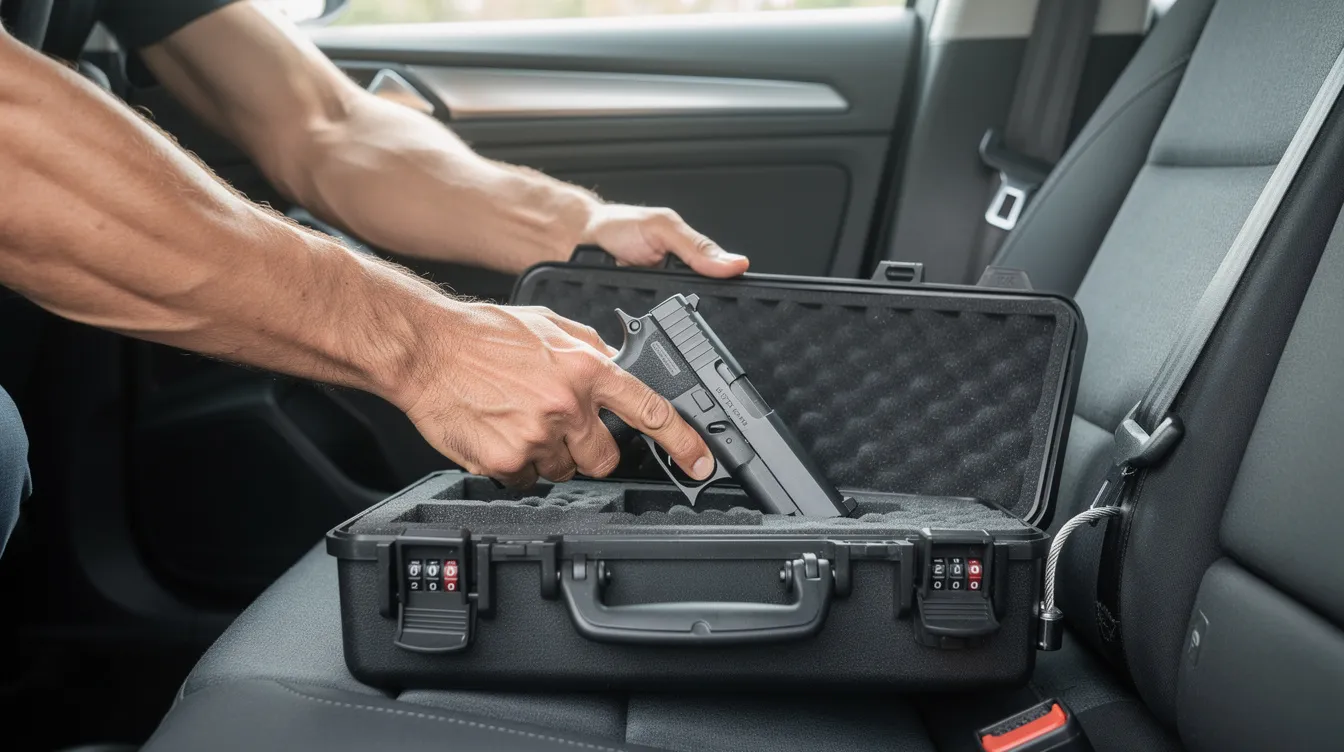
Individuals can carry a loaded firearm in their vehicle without a permit if they may lawfully possess the firearm. This is one of the most practical parts of Missouri gun law for commuters and travelers.
Here are a few everyday examples:
-
A lawful adult driving with a loaded handgun in the glove compartment generally does not need a concealed carry permit.
-
A parent picking up a child from school should understand that the firearm may need to remain locked in the vehicle and not be carried into the building.
-
An employee may be legally allowed to have a gun in a vehicle but still violate workplace policy by bringing it inside.
Federal law, including the Gun-Free School Zones Act, may add restrictions around K–12 schools. Missouri’s permitless carry environment does not erase federal requirements.
Employers can also prohibit employees from carrying weapons at work. Violating a workplace rule may not always be a crime, but it can result in discipline or termination. Rules may differ for private dwellings owned by the employee, employer parking lots, and public facilities.
Missouri law requires disclosure of carrying a firearm only if asked by law enforcement. If a peace officer asks whether you are armed during an official duty stop, answer carefully and follow lawful instructions.

Firearm Types, Assault Weapons, and Magazine Limits
Missouri does not currently have a statewide ban on assault weapons or a general magazine capacity limit. Missouri residents can generally own semiautomatic rifles, pistols, and shotguns if they meet age requirements and are not prohibited by state or federal law.
There is also no state firearm registry in Missouri. No purchase permit or registration is required for firearms in Missouri, and no permit is required to purchase a handgun from a private individual or dealer. However, licensed dealers must still follow federal background check rules.
Federal law still regulates certain firearms and accessories under the National Firearms Act. These may include:
-
machine guns;
-
short-barreled rifles;
-
short-barreled shotguns;
-
silencers or suppressors;
-
destructive devices.
NFA-regulated items generally require federal registration and tax stamps. Failure to follow those rules can bring severe federal penalties. Local ordinances may also regulate unsafe discharge, hunting practices, or use of firearms in populated areas. Future legislation or administrative regulation could change rules on magazines, assault weapons, or public carry.
Self-Defense, Stand Your Ground, and Gun Violence Considerations
Missouri has stand your ground and Castle Doctrine laws. Use of deadly force is justified under Missouri’s Stand Your Ground law when the legal requirements are met, and Missouri’s Castle Doctrine allows the use of deadly force in self-defense in places such as a home, dwelling, or vehicle under qualifying circumstances.
At a high level, lawful self defense usually requires a reasonable belief that deadly force is necessary to prevent imminent death, serious physical injury, or certain violent crimes. Missouri law does not impose a general duty to retreat in many situations where a person is lawfully present, but every defensive shooting will still be investigated.
Do not assume that “stand your ground” means “no consequences.” Police and prosecutors may examine:
-
who started the confrontation;
-
whether the threat was immediate;
-
whether the response was proportional;
-
whether the firearm was displayed in a threatening manner;
-
whether such firearm was used lawfully;
-
whether other persons were endangered.
Missouri also faces serious concerns about gun violence, gun deaths, and gun homicides. Safe storage, training, and responsible carry reduce the risks of accidental shootings, theft, and escalation. Use a gun safe, locking device, or secure storage system, especially around children.
If you are involved in a defensive shooting, call 911, request medical assistance if needed, and contact legal counsel as soon as possible.
Criminal Penalties and Losing Your Gun Rights
Unlawful carry or misuse can lead to charges such as unlawful use of a weapon, unlawful possession, armed criminal action, or federal firearms violations. Under Missouri law, unlawful possession by a prohibited person can be charged as a felony, with penalties increasing for dangerous felony history or repeat offenses.
Long-term consequences can include:
-
loss of gun rights;
-
jail or prison time;
-
loss of a concealed carry permit;
-
employment consequences;
-
inability to pass future background checks;
-
surrender requirements under final orders of protection.
Certain domestic violence convictions and felony convictions can permanently bar firearm possession under federal law. Some court orders can temporarily prohibit possession while the order is active.
Even minor-seeming conduct, such as carrying into a restricted area or showing a firearm in public during a dispute, can create lasting problems. If you are under investigation for gun violence, unlawful possession, or improper carry, consult experienced criminal defense counsel immediately.
FAQ: Missouri Gun Laws
Do I need a permit to buy a handgun or long gun in Missouri?
No. Missouri does not require a state-issued permit or registration to buy a handgun or long gun. There is no state firearm registry in Missouri, and no permit is required to purchase a handgun from a private individual or dealer.
That said, federal law requires background checks for purchases from federally licensed firearms dealers. Private sales between Missouri residents have fewer formal requirements, and private firearm transfers are not subject to background check requirements under state law. Keep personal sale records and never sell to someone you believe is prohibited.
Can non-residents carry concealed in Missouri?
Yes, many non-residents who may lawfully possess firearms under federal law can carry concealed in Missouri without a Missouri-issued concealed carry permit. They must still follow Missouri restricted-place rules, including rules for schools, polling places, government buildings, and posted private property.
Travelers should also check the laws of every state they pass through. A firearm that is lawful in Missouri may create problems in another state.
How does Missouri reciprocity work if I have a CCW permit?
A Missouri concealed carry permit is recognized by many other states, but each state sets its own reciprocity rules. Missouri residents can carry in over 36 states with a permit, and Missouri CCW permits allow carry in 36 other states depending on current law and the type of permit.
Before traveling, confirm current reciprocity maps and the destination state’s rules on vehicle carry, magazine limits, prohibited places, and duty to inform.
Are there special rules for carrying a gun in Missouri state parks or conservation areas?
Firearms are often allowed in Missouri state parks and conservation areas, but discharge, hunting, visitor centers, and specific facilities may have separate rules. Check Missouri Department of Natural Resources and Missouri Department of Conservation rules before carrying or hunting in a specific area.
Federal lands in Missouri, such as certain wildlife refuges or Corps of Engineers properties, may have separate firearm restrictions.
Can I carry a concealed handgun in a bar or restaurant that serves alcohol?
Missouri law has special rules for any establishment licensed to dispense intoxicating liquor. Some restaurant areas may be treated differently from bar areas, especially when a bona fide restaurant open to the public earns most of its gross annual income from food rather than alcohol.
Being intoxicated while handling or carrying a firearm can lead to criminal charges regardless of location. If alcohol is the focus of the business, review current statutes and err on the side of caution.
Conclusion
Missouri gun laws are permissive, but they are not simple. Permitless carry and open carry give lawful adults broad rights, yet schools, government buildings, private property, alcohol-related locations, and federal restrictions can quickly change what is legal.
Before you carry, buy, sell, or use a firearm for self defense, verify the current law and understand the risks. If your situation involves criminal charges, protection orders, or a defensive shooting, speak with a Missouri attorney before making decisions that could affect your freedom and gun rights.
Meta tags
title
Essential Guide to Missouri Gun Laws: What Every Gun Owner Should Know
0/70
description
Discover essential Missouri gun laws every gun owner should know. Stay informed and compliant—read the guide for key insights and practical tips.
0/156