Oregon Gun Laws: 2026 Guide to Carry, Permits, and Restrictions
Oregon Gun Laws: 2026 Guide to Carry, Permits, and Restrictions
Oregon gun laws sit at a crossroads between the state’s constitutional protections and a wave of recent legislation that continues to reshape firearm ownership and carry rules. Whether you’re a lifelong Oregon resident, a first-time gun buyer, or a visitor passing through with a firearm in your vehicle, the legal landscape in 2026 demands your attention. This guide breaks down everything from concealed carry permits and open carry rules to background checks, extreme risk protection orders, and the still-unfolding saga of Measure 114.
This article provides general information about Oregon gun laws and does not constitute legal advice. Readers facing specific legal questions should obtain independent legal counsel before making decisions about firearm ownership, possession, or carry.

Key Takeaways
-
Oregon allows open carry of firearms without a permit statewide, but many cities-including Portland, Beaverton, Eugene, Salem, and others-restrict or prohibit carrying a loaded firearm in public unless you hold a valid Oregon concealed handgun license (CHL).
-
Concealed carry requires an Oregon CHL, which is issued by county sheriffs on a shall-issue basis. Oregon does not recognize concealed carry permits from any other state.
-
The minimum age to purchase rifles and shotguns is 18 years old, while the minimum age to purchase handguns is 21 years old. You must also be at least 21 to obtain an Oregon CHL. SB 243 raised the semiautomatic rifle purchase age to 21 as of September 2025.
-
All firearm sales in Oregon-including private-party and gun show transactions-require a criminal background check. Extreme risk protection orders can temporarily remove guns from individuals deemed a danger, and Oregon’s “red flag” law has been active since 2018.
-
Measure 114’s permit-to-purchase requirement and large capacity magazines ban remain largely paused due to court challenges as of mid-2026. HB 4145 delayed implementation to January 1, 2028, pending the Oregon Supreme Court’s ruling.
Overview of Oregon Gun Laws (As of 2026)
This section provides a quick snapshot of Oregon gun laws for residents, visitors, and gun owners who need to understand the basics before diving into specifics.
Oregon’s Constitution protects the right to bear arms under Article I, Section 27. At the same time, the state enacted a broad range of gun safety laws through statute, voter initiative, and local ordinance. Oregon’s core firearm statutes live in the Oregon Revised Statutes (ORS Chapter 166), which cover everything from concealed weapons to background checks to the definition of a loaded firearm. The state allows some local restrictions on loaded firearms and open carry under ORS 166.173, meaning the rules can change significantly from one city to the next.
Oregon is a shall-issue concealed-carry state, which means county sheriffs must issue a concealed handgun license if the applicant meets all statutory requirements. However, sheriffs retain authority to investigate disqualifying factors, including criminal history, outstanding warrants, and mental health adjudications.
Oregon voters approved Measure 114 in November 2022, introducing a permit-to-purchase system and magazine capacity limits. However, key portions have been stayed by court injunctions and never enforced. The Oregon legislature passed HB 4145 in 2026, pushing the implementation date to January 1, 2028, contingent on the Oregon Supreme Court’s eventual ruling.
Before proceeding through this guide, here are core concepts you’ll encounter:
-
Open carry – carrying a firearm visibly (not concealed), generally permitted without a license under state law
-
Concealed carry permit – the Oregon CHL, required to carry a concealed handgun in public
-
Background check – mandatory screening for all firearm sales in Oregon
-
Extreme risk protection orders – court orders temporarily restricting a person’s firearm access
-
Prohibited person – someone barred from possessing firearms under state or federal law
Who Can Legally Own or Possess a Gun in Oregon
This section explains who can lawfully possess firearms in Oregon, the minimum age requirements, and who is barred from ownership.
Federal Baseline
Under federal law (18 U.S.C. § 922(g)), certain categories of people are prohibited from possessing firearms nationwide. These include:
-
Convicted felons (crimes punishable by imprisonment exceeding one year)
-
Persons convicted of a misdemeanor involving violence in a domestic context
-
Individuals adjudicated as mentally ill or committed to a mental institution
-
Unlawful users of any controlled substance
-
Fugitives from justice
-
Persons under certain restraining orders
-
Those dishonorably discharged from the military
Oregon-Specific Prohibitions
Oregon law adds its own layers. Under Oregon law, convicted felons cannot own or possess firearms, and felons cannot live with someone who possesses a firearm in the same household. Individuals found by a court to pose a danger due to their mental or psychological state, those under extreme risk protection orders, and persons convicted of stalking or certain weapons offenses are also prohibited. Judges must order the transfer of any firearms in a prohibited person’s possession.
Minimum Age Requirements
Oregon’s minimum age rules break down as follows:
|
Firearm Type |
Minimum Purchase Age |
Notes |
|---|---|---|
|
Rifles and shotguns (non-semiauto) |
18 |
From licensed dealer |
|
Semiautomatic rifles |
21 |
Raised by SB 243 (eff. Sept. 2025) |
|
Handguns |
21 |
From licensed dealer |
|
Handgun ammunition |
21 |
Federal and state requirement |
Individuals aged 18 to 20 may purchase and possess certain long guns (non-semiautomatic rifles and shotguns). Minors can use non-handgun firearms with parental consent, and minors may possess firearms for hunting or target practice under direct supervision. However, it is illegal to sell a gun to a minor in Oregon outside of very narrow exceptions.
Restoring Gun Rights
If you have a prior conviction or mental health commitment, restoring firearm rights under Oregon law is possible in some cases-but the process is far from automatic. State-level set-asides or expungements may not satisfy federal law requirements. Oregon State Police have issued denials during background checks for individuals whose rights appear restored under state law but who remain prohibited under federal law. Anyone in this situation should seek independent legal counsel to understand their specific options.
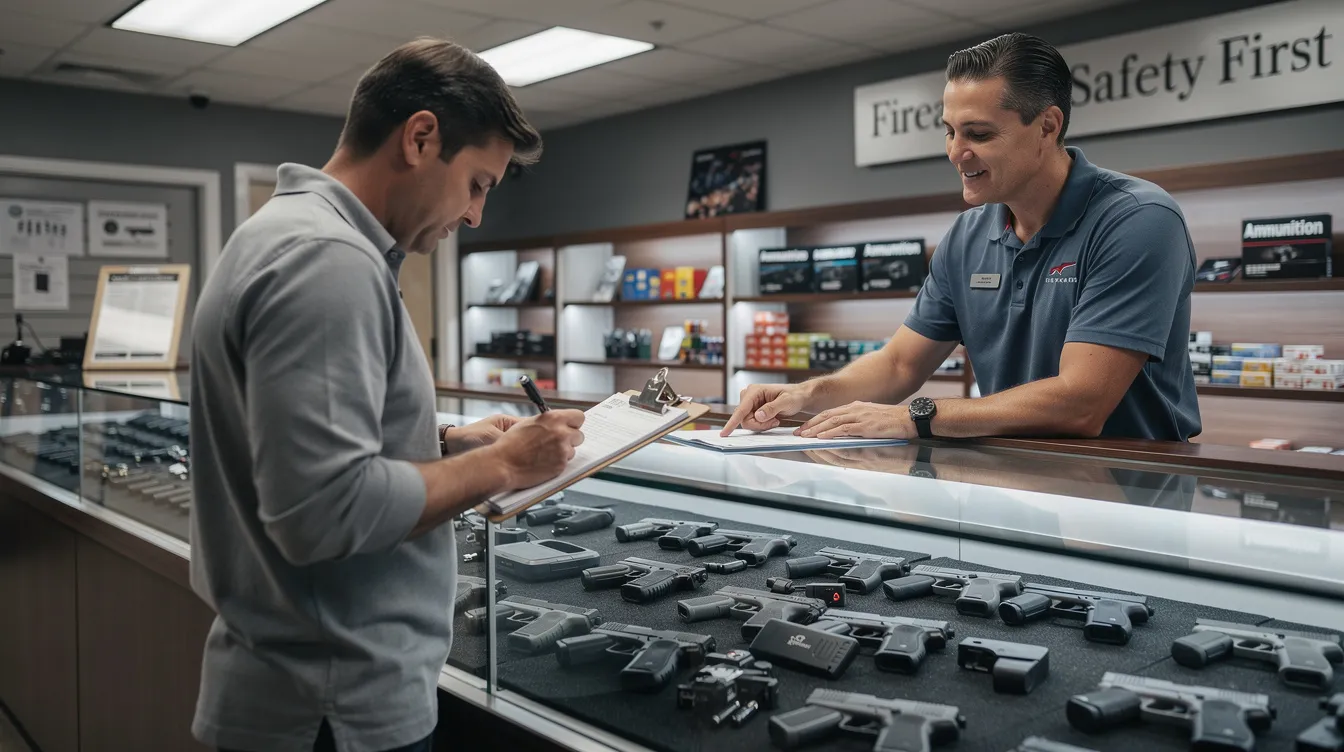
Buying a Gun in Oregon: Background Checks and Permits
This section covers how to buy a firearm legally in Oregon, including background checks, the evolving permit-to-purchase framework, and the new 72-hour waiting period.
Universal Background Checks
Oregon requires background checks for all firearm purchases, regardless of whether the sale occurs at a licensed dealer, a gun show, or between two private individuals. Private sellers must conduct background checks by routing the transaction through a federally licensed firearms dealer. Background checks are mandatory at gun shows just as they are anywhere else in the state. All federally licensed dealers require background checks in Oregon.
The typical process for buying from a dealer works like this:
-
Buyer selects a firearm and completes ATF Form 4473
-
Dealer contacts Oregon State Police for a background check
-
OSP returns a “proceed,” “denied,” or “delay” response
-
If delayed, the dealer waits for OSP to clear the transaction (or, after a statutory period, may transfer under certain conditions)
Private party sales must be completed in person through a federally licensed firearms dealer-no exceptions for online listings or informal arrangements. Oregon law prohibits selling firearms to ineligible individuals, and bypassing the background check requirement can lead to criminal penalties.
SB 243 Waiting Period
As of September 26, 2025, SB 243 introduced a 72-hour waiting period after a buyer’s background check is approved before the dealer may transfer the firearm. This applies on top of whatever processing time the background check itself takes, meaning gun buyers should plan ahead.
Measure 114’s Permit-to-Purchase
Oregon requires a permit to purchase firearms since 2022 under the text of Measure 114, which mandates safety training, fingerprinting, a photo, and law enforcement review before any firearm transfer. Measure 114 mandates a five-year permit validity for firearm purchases. However, as of mid-2026, core components of this ballot measure remain under active litigation and have never been enforced. HB 4145 pushed implementation to January 1, 2028 at the earliest.
Safe Storage
Gun owners in Oregon must securely store firearms in a locked container or use a gun lock. Protective gun safety measures like lock boxes, cable locks, and safes aren’t just good practice-they’re a legal expectation.
Serialization and Homemade Firearms
Oregon law mandates that homemade firearms must be serialized. The growing concern over untraceable ghost guns has driven both state and federal efforts to ensure all firearms-including those assembled from kits-carry proper identification.
Oregon Concealed Carry (Oregon CHL)
This section explains the Oregon concealed handgun license, its requirements, and what the license allows.
Carrying a concealed handgun in public generally requires an Oregon CHL. Carrying a concealed firearm without one is a Class A misdemeanor under ORS 166.250, with limited exceptions for carry within your own home or place of business. Oregon does not recognize concealed carry permits from any other state-no exceptions.
Eligibility Requirements
To qualify for an Oregon CHL, applicants must meet all of the following:
-
Be at least 21 years old
-
Be a U.S. citizen or lawful permanent resident
-
Be an Oregon resident, or a resident of a bordering state who can document continuous residency and demonstrate a compelling business or other interest in Oregon
-
Have no disqualifying felony convictions, no misdemeanor involving violence within the past four years, and no conviction for a controlled substance offense
-
Have no adverse mental health adjudication
-
Have no outstanding warrants
-
Not be subject to a restraining order or ERPO
Training Requirement
You must demonstrate competence with a handgun to obtain a CHL. Acceptable proof includes:
-
Completion of an approved handgun safety course (NRA-certified, law enforcement, or sheriff-approved equivalent)
-
Hunter safety course with a handgun component
-
Military service with handgun qualification of the same rank or higher
-
Other sheriff-approved programs
Application Process
The concealed carry license is issued by each county’s sheriff. The process works as follows:
-
Schedule an in-person appointment at the county sheriff’s office
-
Submit fingerprints and a photograph
-
Pay the application fee (approximately $65 for residents, $50 for renewal; non-residents pay higher fees)
-
Undergo state and federal background checks
The Oregon CHL is valid for four years and renewable with an updated background check and fees. It can be suspended or revoked if the holder engages in new disqualifying conduct, is found guilty of certain offenses, or becomes subject to a restraining order.
Reciprocity
An Oregon CHL is not recognized by many other states, and Oregon does not honor out-of-state concealed carry permits. If you plan to carry concealed weapons across state lines, verify reciprocity laws for every state on your route.
Open Carry and Carrying in Vehicles
Oregon generally allows open carry of firearms, but local rules and vehicle laws create important exceptions that every gun owner should understand.
Statewide Open Carry
Oregon allows open carry of firearms without a permit. Adults who may lawfully possess firearms can carry handguns and long guns openly in many public places, typically using belt holsters or slung over the shoulder. Non-residents can open carry in Oregon without a permit as well, provided they are not otherwise prohibited from possessing firearms.
However, firearms carried openly in certain locations-schools, courthouses, federal buildings-are still prohibited regardless of carry method.
Local Loaded-Carry Restrictions
Here’s where it gets complicated. Local municipalities can restrict loaded open carry in specific areas under ORS 166.173. Cities can restrict open carry of loaded firearms in Oregon, and several major cities do exactly that.
Portland prohibits open carry of loaded firearms without a permit. Loaded firearms are prohibited in public places without a permit in cities including Beaverton, Tigard, Oregon City, Salem, Independence, and Multnomah County. In most of these jurisdictions, Oregon CHL holders are exempt from the local restrictions.
If you’re walking through downtown Portland with a loaded handgun visible on your hip and you don’t have an Oregon CHL, you’re breaking the law-even though statewide rules technically allow open carry.
Vehicle Carry
Without an Oregon CHL, firearms must be unloaded and stored in a closed container in vehicles. A handgun tucked under the seat or in an unlocked glove compartment counts as a concealed handgun and violates the law. Compliant transport means the firearm is unloaded, with the magazine removed, placed in a locked case or the trunk-not in the passenger compartment where it’s readily accessible.
CHL holders may carry a loaded, concealed handgun in a vehicle, including in the passenger compartment, subject to posted restrictions on certain properties.
For long guns, the general rule is to transport them unloaded. Some cities add specific rules about magazine and chamber status, so drivers crossing between jurisdictions should check local ordinances.
Compliant vs. non-compliant vehicle storage example: A driver without a CHL traveling from Bend to Portland places an unloaded handgun in a locked case in the trunk, with ammunition in a separate bag. That’s compliant. The same driver placing a loaded handgun in the center console is not-it’s concealed, loaded, and readily accessible.

Special Restrictions: Prohibited Places, Magazines, and Suppressors
This section covers locations where guns are banned or restricted, plus rules on accessories like large capacity magazines, rapid fire devices, and suppressors.
No-Carry Locations
Under state law and federal law, firearms are strictly prohibited in federal buildings and courthouses. Other restricted locations include:
-
K-12 schools and grounds
-
Many college and university buildings (unless specifically exempt)
-
Secure areas of airports
-
Posted government offices
-
The state capitol, where Oregon prohibits firearms under new regulations enacted via SB 243
Private property owners-including stores, malls, and workplaces-can prohibit guns through posted signage. Violating a posted ban may result in trespass charges even if your carry is otherwise lawful. A law enforcement officer or police officer on duty is typically exempt from these restrictions.
Large Capacity Magazines
Oregon’s new laws ban large capacity magazines for firearms under Measure 114, setting a 10-round limit with grandfathering provisions and exceptions for off-duty law enforcement. However, because Measure 114’s core provisions remain under court injunctions, enforcement of the magazine ban is paused as of mid-2026. High capacity magazines remain legally available for purchase and possession until the courts or legislature say otherwise.
Rapid-Fire Devices
Rapid-fire devices are banned in Oregon, including bump stocks and auto sears. SB 243 prohibits rapid fire devices such as binary triggers, forced-reset triggers, and similar mechanisms that increase a firearm’s rate of fire. Possession is a Class A misdemeanor with significant penalties. This ban is fully enforceable-unlike the magazine limit, it is not subject to any court injunction.
Suppressors and NFA Items
Suppressors (silencers) are legal in Oregon for hunting, home defense, target shooting, and other lawful purposes but remain regulated under the federal National Firearms Act. Acquiring one requires ATF approval, a $200 tax stamp, and purchase through a licensed dealer. A machine gun, short-barreled rifles, and short-barreled shotguns are also heavily restricted and require federal registration. Oregon generally mirrors federal standards for these items, so compliance with ATF rules satisfies state law as well.
Extreme Risk Protection Orders and Mental Health Considerations
This section focuses on extreme risk protection orders (ERPOs) and how mental health can affect gun rights in Oregon.
What Is an ERPO?
Oregon’s “red flag” law, effective since January 1, 2018, allows family members, household members, intimate partners, and any law enforcement agency to petition a circuit court to temporarily restrict a person’s access to firearms. An ERPO is not a criminal charge-it’s a civil court order designed to prevent harm during a crisis.
In the first 22 months after the law took effect, 166 petitions were filed statewide, according to research from Oregon Health & Science University.
The ERPO Process
The petitioner files a sworn affidavit presenting clear and convincing evidence that the respondent poses an imminent risk-whether through suicidal threats, violent behavior, a past pattern of dangerous conduct, or serious substance abuse. A judge reviews the petition (often ex parte, meaning without the respondent present initially) and may issue a temporary order.
Once served, the respondent must surrender all firearms and ammunition within 24 hours. Their CHL is suspended. Extreme risk protection orders can last up to one year in Oregon, and they can be renewed if the risk continues.
Respondents can request a hearing to contest the ERPO with reasonable grounds. They may also seek early termination by presenting convincing evidence that they no longer pose a danger. A judge evaluates whether the original risk factors have changed.
Mental Health Adjudications
Certain mental health findings-such as court-ordered commitments, findings of insanity, or adjudications through a juvenile court involving dangerous behavior-trigger firearm prohibitions under both state and federal law. The Oregon Health Authority and the Department of Human Services may report relevant findings to the background check system.
Prevention Without Legal Processes
Gun safety practices like lock boxes, safes, and cable locks can prevent crisis-driven misuse without necessarily invoking formal legal processes. Voluntary mental health treatment does not, on its own, trigger firearm prohibitions-only involuntary commitment or formal court adjudication does.
Anyone who receives an ERPO notice or has questions about mental health and gun rights should consult an attorney. Violations of an ERPO can lead to criminal charges, and the consequences of unlawful possession extend well beyond the order itself.
Local Variations: Portland and Other Oregon Cities
While Oregon law provides a statewide baseline, major cities layer on their own specific rules that significantly affect carrying loaded firearms and open carry.
Portland
Portland’s ordinances (Portland Code Chapter 14A.60) impose a general prohibition on openly carrying loaded firearms in public without an Oregon CHL. In Portland and Multnomah County, a CHL holder may carry a loaded, concealed firearm, but open carry without a license is restricted. The same applies to carrying in city parks, certain transit areas, and near government buildings.
Other Cities with Local Restrictions
The following cities impose similar restrictions on loaded firearms in public places:
|
City |
Loaded Open Carry Ban? |
CHL Exemption? |
|---|---|---|
|
Portland |
Yes |
Yes |
|
Beaverton |
Yes |
Yes |
|
Tigard |
Yes |
Yes |
|
Oregon City |
Yes |
Yes |
|
Salem |
Yes |
Yes |
|
Independence |
Yes |
Yes |
|
Eugene |
Yes |
Yes |
These local gun codes often extend to parks, government buildings, and downtown areas. If you’re traveling between jurisdictions, the rules may change within a few miles.
State Preemption and Its Limits
Oregon has state preemption under ORS 166.170, which generally prevents local governments from regulating the sale, possession, or transfer of firearms. However, ORS 166.173 carves out authority for cities and counties to restrict firearms in two key areas: possession of loaded firearms in public places, and-under SB 243-carrying in government-owned buildings with posted notice.
Tribal Lands
Tribal lands and Indian reservations in Oregon have their own firearm regulations, and state permits may not apply on tribal property. Federal law and tribal law often control. If you plan to carry on reservation land, contact the tribal government directly for their specific rules.

Special Topics: Non-Residents, Travel, and Hunting
This section covers visitors to Oregon, interstate travel with guns, and basic hunting-related firearm rules.
Non-Resident Concealed Carry
Oregon does not recognize concealed carry permits from any other state. Non-residents must generally obtain an Oregon CHL to carry concealed within the state. Non-residents from bordering states (Washington, Idaho, Nevada, and California) can apply in border counties if they can show a compelling business or other interest and document continuous residency in their home state.
Non-residents can open carry firearms in Oregon without a permit, provided the firearm is unloaded in jurisdictions with loaded-carry bans and the person is not otherwise prohibited.
Traveling to Oregon by Car
If you’re driving into Oregon with firearms:
-
Firearms should be unloaded, cased, and stored separately from ammunition
-
Comply with both Oregon and en-route state laws
-
Be aware that local vehicle-carry ordinances may apply once you enter city limits
-
A CHL from your home state will not protect you in Oregon
Flying with a Firearm
TSA requires that firearms must be transported in a locked hard case when flying, declared at check-in, and placed in checked baggage. Ammunition must be in its original packaging or a container designed for it. Once you land in Oregon, you’re subject to Oregon transport laws-meaning the firearm stays unloaded and cased until you reach your destination and can comply with state and local rules.
Hunting
Hunting firearm regulations are managed by the Oregon Department of Fish and Wildlife (ODFW). Key points include:
-
Allowed calibers and shotgun gauges vary by game species and season
-
Seasons and tags must be current-possessing a firearm in a hunting area outside of your permitted season can draw scrutiny
-
Loaded firearms in vehicles while hunting are generally prohibited under ODFW rules
-
Self defense considerations while hunting on public land don’t override game regulations
Hunters should verify current ODFW regulations each season, especially regarding semiautomatic rifles, magazine limits in the field, and areas where discharging a firearm is prohibited for safety reasons. Target practice and target shooting on public lands must also comply with fire-season restrictions and local closures.
Penalties for Violating Oregon Gun Laws
This section outlines the seriousness of gun-law violations and typical penalties. It is general information, not legal advice-anyone facing charges should seek qualified representation.
Unlawful Possession
Possession of a firearm by a felon is a Class C felony under Oregon law. A felon caught with a firearm faces up to 5 years in prison and substantial fines. Unlawful possession charges also apply to minors, persons under ERPOs, and anyone otherwise prohibited from possessing firearms. Being found guilty of these offenses creates a permanent criminal record.
Carrying Concealed Without a CHL
Carrying a concealed handgun without an Oregon CHL is a Class A misdemeanor, punishable by up to 364 days in jail and fines. Repeat offenses or aggravating factors (such as carrying a deadly weapon during commission of another crime) can elevate charges.
Other Violations
|
Violation |
Typical Penalty |
|---|---|
|
Bypassing background check (private sale) |
Criminal charges, firearm seizure |
|
Straw purchase |
Federal felony, up to 10 years |
|
Bringing firearms into prohibited places |
Arrest, firearm seizure, trespass charges |
|
Violating local loaded-carry bans |
Fines up to $500, possible jail time |
|
Violating an ERPO |
Criminal charges, extended restrictions |
|
Providing a firearm to a prohibited person |
Felony charges under state and federal law |
The gun industry and advocacy groups often remind owners that a single violation can permanently affect gun rights, employment, and immigration status. Anyone charged with a firearm offense should seek a free consultation with a qualified attorney as quickly as possible.

FAQ: Oregon Gun Laws
These FAQs cover common questions not fully addressed above. Answers are general information and do not constitute legal advice-the authority to interpret Oregon law is vested solely in its courts. For case-specific guidance, obtain independent legal counsel.
Can I wear a mask while carrying a concealed handgun in Oregon?
Oregon law does not prohibit lawfully carrying a concealed handgun while wearing a mask for health reasons, cold weather, or any other non-criminal purpose, as long as you have a valid Oregon CHL and are not otherwise violating any law. Committing a crime while masked may lead to enhanced penalties, but merely combining mask-wearing with lawful concealed carry is generally allowed. Keep your CHL and identification readily available in case a law enforcement officer makes contact.
Do expunged or set-aside convictions automatically restore my gun rights in Oregon?
No. Oregon’s set-aside or expungement of certain convictions does not always restore firearm rights under federal law, especially for felony convictions. A 2025 Oregon State Police policy change led to new denials for some gun buyers whose rights appear restored under state law but remain restricted federally. The distinction between state and federal eligibility is a common trap. If you have a prior conviction, consult an attorney about specific restoration procedures-such as rights-restoration petitions, felony reductions to misdemeanor status, or federal relief where available-before attempting to purchase or possess firearms.
Can I carry a firearm in Oregon state parks, national forests, and BLM land?
Lawful firearm possession-including open carry and concealed carry with an Oregon CHL-is generally allowed in Oregon state parks, national forests, and on BLM land, unless posted otherwise. However, discharging firearms is restricted to certain areas (like designated shooting sites or in-season hunting zones) and is prohibited near campgrounds, trailheads, and high-use recreation areas. Federal facilities within these lands-visitor centers, ranger stations, some dam structures-often prohibit guns regardless of state law, so pay attention to signage. A lawful purpose for carrying, such as self defense or wildlife protection, does not override area-specific discharge bans.
What happens if my Oregon CHL application is denied?
You must receive a written reason for denial from the sheriff. Common denial grounds include criminal history, active restraining orders, or adverse mental health findings. Oregon law allows appeals to the circuit court, typically within 30 days of denial, where a judge reviews whether the sheriff’s decision complied with statutory standards. Before reapplying or appealing, correct any record errors (mistaken identity, outdated data) and consider legal counsel. Some applicants are denied based on records from other states that may not accurately reflect their current eligibility.
Are “ghost guns” or homemade firearms legal in Oregon?
Under recent federal rules, many unserialized “ghost gun” kits now count as firearms and must go through licensed dealers with background checks. Oregon follows federal definitions and mandates that homemade firearms must be serialized. Manufacturing a firearm for personal use without a serial number can conflict with federal law, particularly if any sale or transfer occurs. The restrict firearms approach to untraceable ghost guns reflects both state and federal priorities. Avoid building or buying unserialized firearms-purchase through licensed dealers to ensure compliance with both Oregon and federal regulations.
Oregon Gun Laws: 2026 Guide to Carry, Permits, and Restrictions
Oregon gun laws sit at a crossroads between the state’s constitutional protections and a wave of recent legislation that continues to reshape firearm ownership and carry rules. Whether you’re a lifelong Oregon resident, a first-time gun buyer, or a visitor passing through with a firearm in your vehicle, the legal landscape in 2026 demands your attention. This guide breaks down everything from concealed carry permits and open carry rules to background checks, extreme risk protection orders, and the still-unfolding saga of Measure 114.
This article provides general information about Oregon gun laws and does not constitute legal advice. Readers facing specific legal questions should obtain independent legal counsel before making decisions about firearm ownership, possession, or carry.
Key Takeaways
-
Oregon allows open carry of firearms without a permit statewide, but many cities-including Portland, Beaverton, Eugene, Salem, and others-restrict or prohibit carrying a loaded firearm in public unless you hold a valid Oregon concealed handgun license (CHL).
-
Concealed carry requires an Oregon CHL, which is issued by county sheriffs on a shall-issue basis. Oregon does not recognize concealed carry permits from any other state.
-
The minimum age to purchase rifles and shotguns is 18 years old, while the minimum age to purchase handguns is 21 years old. You must also be at least 21 to obtain an Oregon CHL. SB 243 raised the semiautomatic rifle purchase age to 21 as of September 2025.
-
All firearm sales in Oregon-including private-party and gun show transactions-require a criminal background check. Extreme risk protection orders can temporarily remove guns from individuals deemed a danger, and Oregon’s “red flag” law has been active since 2018.
-
Measure 114’s permit-to-purchase requirement and large capacity magazines ban remain largely paused due to court challenges as of mid-2026. HB 4145 delayed implementation to January 1, 2028, pending the Oregon Supreme Court’s ruling.
Overview of Oregon Gun Laws (As of 2026)
This section provides a quick snapshot of Oregon gun laws for residents, visitors, and gun owners who need to understand the basics before diving into specifics.
Oregon’s Constitution protects the right to bear arms under Article I, Section 27. At the same time, the state enacted a broad range of gun safety laws through statute, voter initiative, and local ordinance. Oregon’s core firearm statutes live in the Oregon Revised Statutes (ORS Chapter 166), which cover everything from concealed weapons to background checks to the definition of a loaded firearm. The state allows some local restrictions on loaded firearms and open carry under ORS 166.173, meaning the rules can change significantly from one city to the next.
Oregon is a shall-issue concealed-carry state, which means county sheriffs must issue a concealed handgun license if the applicant meets all statutory requirements. However, sheriffs retain authority to investigate disqualifying factors, including criminal history, outstanding warrants, and mental health adjudications.
Oregon voters approved Measure 114 in November 2022, introducing a permit-to-purchase system and magazine capacity limits. However, key portions have been stayed by court injunctions and never enforced. The Oregon legislature passed HB 4145 in 2026, pushing the implementation date to January 1, 2028, contingent on the Oregon Supreme Court’s eventual ruling.
Before proceeding through this guide, here are core concepts you’ll encounter:
-
Open carry – carrying a firearm visibly (not concealed), generally permitted without a license under state law
-
Concealed carry permit – the Oregon CHL, required to carry a concealed handgun in public
-
Background check – mandatory screening for all firearm sales in Oregon
-
Extreme risk protection orders – court orders temporarily restricting a person’s firearm access
-
Prohibited person – someone barred from possessing firearms under state or federal law
Who Can Legally Own or Possess a Gun in Oregon
This section explains who can lawfully possess firearms in Oregon, the minimum age requirements, and who is barred from ownership.
Federal Baseline
Under federal law (18 U.S.C. § 922(g)), certain categories of people are prohibited from possessing firearms nationwide. These include:
-
Convicted felons (crimes punishable by imprisonment exceeding one year)
-
Persons convicted of a misdemeanor involving violence in a domestic context
-
Individuals adjudicated as mentally ill or committed to a mental institution
-
Unlawful users of any controlled substance
-
Fugitives from justice
-
Persons under certain restraining orders
-
Those dishonorably discharged from the military
Oregon-Specific Prohibitions
Oregon law adds its own layers. Under Oregon law, convicted felons cannot own or possess firearms, and felons cannot live with someone who possesses a firearm in the same household. Individuals found by a court to pose a danger due to their mental or psychological state, those under extreme risk protection orders, and persons convicted of stalking or certain weapons offenses are also prohibited. Judges must order the transfer of any firearms in a prohibited person’s possession.
Minimum Age Requirements
Oregon’s minimum age rules break down as follows:
|
Firearm Type |
Minimum Purchase Age |
Notes |
|---|---|---|
|
Rifles and shotguns (non-semiauto) |
18 |
From licensed dealer |
|
Semiautomatic rifles |
21 |
Raised by SB 243 (eff. Sept. 2025) |
|
Handguns |
21 |
From licensed dealer |
|
Handgun ammunition |
21 |
Federal and state requirement |
Individuals aged 18 to 20 may purchase and possess certain long guns (non-semiautomatic rifles and shotguns). Minors can use non-handgun firearms with parental consent, and minors may possess firearms for hunting or target practice under direct supervision. However, it is illegal to sell a gun to a minor in Oregon outside of very narrow exceptions.
Restoring Gun Rights
If you have a prior conviction or mental health commitment, restoring firearm rights under Oregon law is possible in some cases-but the process is far from automatic. State-level set-asides or expungements may not satisfy federal law requirements. Oregon State Police have issued denials during background checks for individuals whose rights appear restored under state law but who remain prohibited under federal law. Anyone in this situation should seek independent legal counsel to understand their specific options.
Buying a Gun in Oregon: Background Checks and Permits
This section covers how to buy a firearm legally in Oregon, including background checks, the evolving permit-to-purchase framework, and the new 72-hour waiting period.
Universal Background Checks
Oregon requires background checks for all firearm purchases, regardless of whether the sale occurs at a licensed dealer, a gun show, or between two private individuals. Private sellers must conduct background checks by routing the transaction through a federally licensed firearms dealer. Background checks are mandatory at gun shows just as they are anywhere else in the state. All federally licensed dealers require background checks in Oregon.
The typical process for buying from a dealer works like this:
-
Buyer selects a firearm and completes ATF Form 4473
-
Dealer contacts Oregon State Police for a background check
-
OSP returns a “proceed,” “denied,” or “delay” response
-
If delayed, the dealer waits for OSP to clear the transaction (or, after a statutory period, may transfer under certain conditions)
Private party sales must be completed in person through a federally licensed firearms dealer-no exceptions for online listings or informal arrangements. Oregon law prohibits selling firearms to ineligible individuals, and bypassing the background check requirement can lead to criminal penalties.
SB 243 Waiting Period
As of September 26, 2025, SB 243 introduced a 72-hour waiting period after a buyer’s background check is approved before the dealer may transfer the firearm. This applies on top of whatever processing time the background check itself takes, meaning gun buyers should plan ahead.
Measure 114’s Permit-to-Purchase
Oregon requires a permit to purchase firearms since 2022 under the text of Measure 114, which mandates safety training, fingerprinting, a photo, and law enforcement review before any firearm transfer. Measure 114 mandates a five-year permit validity for firearm purchases. However, as of mid-2026, core components of this ballot measure remain under active litigation and have never been enforced. HB 4145 pushed implementation to January 1, 2028 at the earliest.
Safe Storage
Gun owners in Oregon must securely store firearms in a locked container or use a gun lock. Protective gun safety measures like lock boxes, cable locks, and safes aren’t just good practice-they’re a legal expectation.
Serialization and Homemade Firearms
Oregon law mandates that homemade firearms must be serialized. The growing concern over untraceable ghost guns has driven both state and federal efforts to ensure all firearms-including those assembled from kits-carry proper identification.
Oregon Concealed Carry (Oregon CHL)
This section explains the Oregon concealed handgun license, its requirements, and what the license allows.
Carrying a concealed handgun in public generally requires an Oregon CHL. Carrying a concealed firearm without one is a Class A misdemeanor under ORS 166.250, with limited exceptions for carry within your own home or place of business. Oregon does not recognize concealed carry permits from any other state-no exceptions.
Eligibility Requirements
To qualify for an Oregon CHL, applicants must meet all of the following:
-
Be at least 21 years old
-
Be a U.S. citizen or lawful permanent resident
-
Be an Oregon resident, or a resident of a bordering state who can document continuous residency and demonstrate a compelling business or other interest in Oregon
-
Have no disqualifying felony convictions, no misdemeanor involving violence within the past four years, and no conviction for a controlled substance offense
-
Have no adverse mental health adjudication
-
Have no outstanding warrants
-
Not be subject to a restraining order or ERPO
Training Requirement
You must demonstrate competence with a handgun to obtain a CHL. Acceptable proof includes:
-
Completion of an approved handgun safety course (NRA-certified, law enforcement, or sheriff-approved equivalent)
-
Hunter safety course with a handgun component
-
Military service with handgun qualification of the same rank or higher
-
Other sheriff-approved programs
Application Process
The concealed carry license is issued by each county’s sheriff. The process works as follows:
-
Schedule an in-person appointment at the county sheriff’s office
-
Submit fingerprints and a photograph
-
Pay the application fee (approximately $65 for residents, $50 for renewal; non-residents pay higher fees)
-
Undergo state and federal background checks
The Oregon CHL is valid for four years and renewable with an updated background check and fees. It can be suspended or revoked if the holder engages in new disqualifying conduct, is found guilty of certain offenses, or becomes subject to a restraining order.
Reciprocity
An Oregon CHL is not recognized by many other states, and Oregon does not honor out-of-state concealed carry permits. If you plan to carry concealed weapons across state lines, verify reciprocity laws for every state on your route.
Open Carry and Carrying in Vehicles
Oregon generally allows open carry of firearms, but local rules and vehicle laws create important exceptions that every gun owner should understand.
Statewide Open Carry
Oregon allows open carry of firearms without a permit. Adults who may lawfully possess firearms can carry handguns and long guns openly in many public places, typically using belt holsters or slung over the shoulder. Non-residents can open carry in Oregon without a permit as well, provided they are not otherwise prohibited from possessing firearms.
However, firearms carried openly in certain locations-schools, courthouses, federal buildings-are still prohibited regardless of carry method.
Local Loaded-Carry Restrictions
Here’s where it gets complicated. Local municipalities can restrict loaded open carry in specific areas under ORS 166.173. Cities can restrict open carry of loaded firearms in Oregon, and several major cities do exactly that.
Portland prohibits open carry of loaded firearms without a permit. Loaded firearms are prohibited in public places without a permit in cities including Beaverton, Tigard, Oregon City, Salem, Independence, and Multnomah County. In most of these jurisdictions, Oregon CHL holders are exempt from the local restrictions.
If you’re walking through downtown Portland with a loaded handgun visible on your hip and you don’t have an Oregon CHL, you’re breaking the law-even though statewide rules technically allow open carry.
Vehicle Carry
Without an Oregon CHL, firearms must be unloaded and stored in a closed container in vehicles. A handgun tucked under the seat or in an unlocked glove compartment counts as a concealed handgun and violates the law. Compliant transport means the firearm is unloaded, with the magazine removed, placed in a locked case or the trunk-not in the passenger compartment where it’s readily accessible.
CHL holders may carry a loaded, concealed handgun in a vehicle, including in the passenger compartment, subject to posted restrictions on certain properties.
For long guns, the general rule is to transport them unloaded. Some cities add specific rules about magazine and chamber status, so drivers crossing between jurisdictions should check local ordinances.
Compliant vs. non-compliant vehicle storage example: A driver without a CHL traveling from Bend to Portland places an unloaded handgun in a locked case in the trunk, with ammunition in a separate bag. That’s compliant. The same driver placing a loaded handgun in the center console is not-it’s concealed, loaded, and readily accessible.
Special Restrictions: Prohibited Places, Magazines, and Suppressors
This section covers locations where guns are banned or restricted, plus rules on accessories like large capacity magazines, rapid fire devices, and suppressors.
No-Carry Locations
Under state law and federal law, firearms are strictly prohibited in federal buildings and courthouses. Other restricted locations include:
-
K-12 schools and grounds
-
Many college and university buildings (unless specifically exempt)
-
Secure areas of airports
-
Posted government offices
-
The state capitol, where Oregon prohibits firearms under new regulations enacted via SB 243
Private property owners-including stores, malls, and workplaces-can prohibit guns through posted signage. Violating a posted ban may result in trespass charges even if your carry is otherwise lawful. A law enforcement officer or police officer on duty is typically exempt from these restrictions.
Large Capacity Magazines
Oregon’s new laws ban large capacity magazines for firearms under Measure 114, setting a 10-round limit with grandfathering provisions and exceptions for off-duty law enforcement. However, because Measure 114’s core provisions remain under court injunctions, enforcement of the magazine ban is paused as of mid-2026. High capacity magazines remain legally available for purchase and possession until the courts or legislature say otherwise.
Rapid-Fire Devices
Rapid-fire devices are banned in Oregon, including bump stocks and auto sears. SB 243 prohibits rapid fire devices such as binary triggers, forced-reset triggers, and similar mechanisms that increase a firearm’s rate of fire. Possession is a Class A misdemeanor with significant penalties. This ban is fully enforceable-unlike the magazine limit, it is not subject to any court injunction.
Suppressors and NFA Items
Suppressors (silencers) are legal in Oregon for hunting, home defense, target shooting, and other lawful purposes but remain regulated under the federal National Firearms Act. Acquiring one requires ATF approval, a $200 tax stamp, and purchase through a licensed dealer. A machine gun, short-barreled rifles, and short-barreled shotguns are also heavily restricted and require federal registration. Oregon generally mirrors federal standards for these items, so compliance with ATF rules satisfies state law as well.
Extreme Risk Protection Orders and Mental Health Considerations
This section focuses on extreme risk protection orders (ERPOs) and how mental health can affect gun rights in Oregon.
What Is an ERPO?
Oregon’s “red flag” law, effective since January 1, 2018, allows family members, household members, intimate partners, and any law enforcement agency to petition a circuit court to temporarily restrict a person’s access to firearms. An ERPO is not a criminal charge-it’s a civil court order designed to prevent harm during a crisis.
In the first 22 months after the law took effect, 166 petitions were filed statewide, according to research from Oregon Health & Science University.
The ERPO Process
The petitioner files a sworn affidavit presenting clear and convincing evidence that the respondent poses an imminent risk-whether through suicidal threats, violent behavior, a past pattern of dangerous conduct, or serious substance abuse. A judge reviews the petition (often ex parte, meaning without the respondent present initially) and may issue a temporary order.
Once served, the respondent must surrender all firearms and ammunition within 24 hours. Their CHL is suspended. Extreme risk protection orders can last up to one year in Oregon, and they can be renewed if the risk continues.
Respondents can request a hearing to contest the ERPO with reasonable grounds. They may also seek early termination by presenting convincing evidence that they no longer pose a danger. A judge evaluates whether the original risk factors have changed.
Mental Health Adjudications
Certain mental health findings-such as court-ordered commitments, findings of insanity, or adjudications through a juvenile court involving dangerous behavior-trigger firearm prohibitions under both state and federal law. The Oregon Health Authority and the Department of Human Services may report relevant findings to the background check system.
Prevention Without Legal Processes
Gun safety practices like lock boxes, safes, and cable locks can prevent crisis-driven misuse without necessarily invoking formal legal processes. Voluntary mental health treatment does not, on its own, trigger firearm prohibitions-only involuntary commitment or formal court adjudication does.
Anyone who receives an ERPO notice or has questions about mental health and gun rights should consult an attorney. Violations of an ERPO can lead to criminal charges, and the consequences of unlawful possession extend well beyond the order itself.
Local Variations: Portland and Other Oregon Cities
While Oregon law provides a statewide baseline, major cities layer on their own specific rules that significantly affect carrying loaded firearms and open carry.
Portland
Portland’s ordinances (Portland Code Chapter 14A.60) impose a general prohibition on openly carrying loaded firearms in public without an Oregon CHL. In Portland and Multnomah County, a CHL holder may carry a loaded, concealed firearm, but open carry without a license is restricted. The same applies to carrying in city parks, certain transit areas, and near government buildings.
Other Cities with Local Restrictions
The following cities impose similar restrictions on loaded firearms in public places:
|
City |
Loaded Open Carry Ban? |
CHL Exemption? |
|---|---|---|
|
Portland |
Yes |
Yes |
|
Beaverton |
Yes |
Yes |
|
Tigard |
Yes |
Yes |
|
Oregon City |
Yes |
Yes |
|
Salem |
Yes |
Yes |
|
Independence |
Yes |
Yes |
|
Eugene |
Yes |
Yes |
These local gun codes often extend to parks, government buildings, and downtown areas. If you’re traveling between jurisdictions, the rules may change within a few miles.
State Preemption and Its Limits
Oregon has state preemption under ORS 166.170, which generally prevents local governments from regulating the sale, possession, or transfer of firearms. However, ORS 166.173 carves out authority for cities and counties to restrict firearms in two key areas: possession of loaded firearms in public places, and-under SB 243-carrying in government-owned buildings with posted notice.
Tribal Lands
Tribal lands and Indian reservations in Oregon have their own firearm regulations, and state permits may not apply on tribal property. Federal law and tribal law often control. If you plan to carry on reservation land, contact the tribal government directly for their specific rules.
Special Topics: Non-Residents, Travel, and Hunting
This section covers visitors to Oregon, interstate travel with guns, and basic hunting-related firearm rules.
Non-Resident Concealed Carry
Oregon does not recognize concealed carry permits from any other state. Non-residents must generally obtain an Oregon CHL to carry concealed within the state. Non-residents from bordering states (Washington, Idaho, Nevada, and California) can apply in border counties if they can show a compelling business or other interest and document continuous residency in their home state.
Non-residents can open carry firearms in Oregon without a permit, provided the firearm is unloaded in jurisdictions with loaded-carry bans and the person is not otherwise prohibited.
Traveling to Oregon by Car
If you’re driving into Oregon with firearms:
-
Firearms should be unloaded, cased, and stored separately from ammunition
-
Comply with both Oregon and en-route state laws
-
Be aware that local vehicle-carry ordinances may apply once you enter city limits
-
A CHL from your home state will not protect you in Oregon
Flying with a Firearm
TSA requires that firearms must be transported in a locked hard case when flying, declared at check-in, and placed in checked baggage. Ammunition must be in its original packaging or a container designed for it. Once you land in Oregon, you’re subject to Oregon transport laws-meaning the firearm stays unloaded and cased until you reach your destination and can comply with state and local rules.
Hunting
Hunting firearm regulations are managed by the Oregon Department of Fish and Wildlife (ODFW). Key points include:
-
Allowed calibers and shotgun gauges vary by game species and season
-
Seasons and tags must be current-possessing a firearm in a hunting area outside of your permitted season can draw scrutiny
-
Loaded firearms in vehicles while hunting are generally prohibited under ODFW rules
-
Self defense considerations while hunting on public land don’t override game regulations
Hunters should verify current ODFW regulations each season, especially regarding semiautomatic rifles, magazine limits in the field, and areas where discharging a firearm is prohibited for safety reasons. Target practice and target shooting on public lands must also comply with fire-season restrictions and local closures.
Penalties for Violating Oregon Gun Laws
This section outlines the seriousness of gun-law violations and typical penalties. It is general information, not legal advice-anyone facing charges should seek qualified representation.
Unlawful Possession
Possession of a firearm by a felon is a Class C felony under Oregon law. A felon caught with a firearm faces up to 5 years in prison and substantial fines. Unlawful possession charges also apply to minors, persons under ERPOs, and anyone otherwise prohibited from possessing firearms. Being found guilty of these offenses creates a permanent criminal record.
Carrying Concealed Without a CHL
Carrying a concealed handgun without an Oregon CHL is a Class A misdemeanor, punishable by up to 364 days in jail and fines. Repeat offenses or aggravating factors (such as carrying a deadly weapon during commission of another crime) can elevate charges.
Other Violations
|
Violation |
Typical Penalty |
|---|---|
|
Bypassing background check (private sale) |
Criminal charges, firearm seizure |
|
Straw purchase |
Federal felony, up to 10 years |
|
Bringing firearms into prohibited places |
Arrest, firearm seizure, trespass charges |
|
Violating local loaded-carry bans |
Fines up to $500, possible jail time |
|
Violating an ERPO |
Criminal charges, extended restrictions |
|
Providing a firearm to a prohibited person |
Felony charges under state and federal law |
The gun industry and advocacy groups often remind owners that a single violation can permanently affect gun rights, employment, and immigration status. Anyone charged with a firearm offense should seek a free consultation with a qualified attorney as quickly as possible.
FAQ: Oregon Gun Laws
These FAQs cover common questions not fully addressed above. Answers are general information and do not constitute legal advice-the authority to interpret Oregon law is vested solely in its courts. For case-specific guidance, obtain independent legal counsel.
Can I wear a mask while carrying a concealed handgun in Oregon?
Oregon law does not prohibit lawfully carrying a concealed handgun while wearing a mask for health reasons, cold weather, or any other non-criminal purpose, as long as you have a valid Oregon CHL and are not otherwise violating any law. Committing a crime while masked may lead to enhanced penalties, but merely combining mask-wearing with lawful concealed carry is generally allowed. Keep your CHL and identification readily available in case a law enforcement officer makes contact.
Do expunged or set-aside convictions automatically restore my gun rights in Oregon?
No. Oregon’s set-aside or expungement of certain convictions does not always restore firearm rights under federal law, especially for felony convictions. A 2025 Oregon State Police policy change led to new denials for some gun buyers whose rights appear restored under state law but remain restricted federally. The distinction between state and federal eligibility is a common trap. If you have a prior conviction, consult an attorney about specific restoration procedures-such as rights-restoration petitions, felony reductions to misdemeanor status, or federal relief where available-before attempting to purchase or possess firearms.
Can I carry a firearm in Oregon state parks, national forests, and BLM land?
Lawful firearm possession-including open carry and concealed carry with an Oregon CHL-is generally allowed in Oregon state parks, national forests, and on BLM land, unless posted otherwise. However, discharging firearms is restricted to certain areas (like designated shooting sites or in-season hunting zones) and is prohibited near campgrounds, trailheads, and high-use recreation areas. Federal facilities within these lands-visitor centers, ranger stations, some dam structures-often prohibit guns regardless of state law, so pay attention to signage. A lawful purpose for carrying, such as self defense or wildlife protection, does not override area-specific discharge bans.
What happens if my Oregon CHL application is denied?
You must receive a written reason for denial from the sheriff. Common denial grounds include criminal history, active restraining orders, or adverse mental health findings. Oregon law allows appeals to the circuit court, typically within 30 days of denial, where a judge reviews whether the sheriff’s decision complied with statutory standards. Before reapplying or appealing, correct any record errors (mistaken identity, outdated data) and consider legal counsel. Some applicants are denied based on records from other states that may not accurately reflect their current eligibility.
Are “ghost guns” or homemade firearms legal in Oregon?
Under recent federal rules, many unserialized “ghost gun” kits now count as firearms and must go through licensed dealers with background checks. Oregon follows federal definitions and mandates that homemade firearms must be serialized. Manufacturing a firearm for personal use without a serial number can conflict with federal law, particularly if any sale or transfer occurs. The restrict firearms approach to untraceable ghost guns reflects both state and federal priorities. Avoid building or buying unserialized firearms-purchase through licensed dealers to ensure compliance with both Oregon and federal regulations.
Oregon gun laws continue to evolve rapidly. Between the Oregon legislature’s recent action on SB 243, the unresolved fate of Measure 114, and the patchwork of local restrictions across cities like Portland and Salem, staying current isn’t optional-it’s essential for anyone who owns, carries, or plans to purchase a firearm in this state. Bookmark this guide, check back as court rulings develop, and when in doubt, consult a qualified Oregon firearms attorney before making any decisions that could affect your rights or freedom.
Meta tags
title
Understanding Oregon Gun Laws: Key Rules and Regulations Explained
66/70
description
Explore Oregon’s gun laws with clarity. Understand key rules and regulations to stay informed and compliant. Read the article for essential insights.
149/156