Massachusetts Gun Laws: Comprehensive 2026 Overview
Massachusetts Gun Laws: Comprehensive 2026 Overview
Massachusetts maintains some of the strictest gun laws in the United States. Whether you are a lifelong Bay State resident, someone moving here from out of state, or simply trying to understand how firearms laws work in the Commonwealth, this guide walks through licensing requirements, prohibited weapons, storage rules, and the major legal changes that took effect under the 2024 reforms. Everything below reflects the law as of mid-2026, but given how quickly firearms laws evolve, always verify details with your local licensing authority or a qualified attorney before making decisions.
Key Takeaways
-
Massachusetts requires nearly all residents to hold either a firearms identification card or a license to carry before they can legally possess, purchase firearms, or carry firearms in the Commonwealth. Background checks, mandatory training, and a personal interview are part of every application.
-
The state bans new sales of most assault weapons and large capacity feeding devices manufactured or acquired after September 13, 1994. Magazines holding more than 10 rounds are prohibited for handguns and rifles, and machine gun possession is limited to narrow exceptions.
-
Firearms must be stored in a locked container when not in use, and transport rules require guns to be unloaded and secured. Firearm theft must be reported within seven days.
-
Massachusetts also focuses on suicide prevention and risk-based firearm removal through extreme risk protection orders, public education campaigns, and partnerships with crisis hotlines.
-
Laws are subject to change through litigation, regulatory updates, and potential ballot initiatives. Readers should check Mass.gov’s firearms laws page and consult legal counsel for case-specific guidance.

Overview of Massachusetts Firearms Laws
Massachusetts gun laws are primarily found in M.G.L. Chapter 140, Sections 121 through 131Q, which cover licensing, sales, definitions, and prohibited weapons. Chapter 269 addresses weapons crimes and associated penalties. Two landmark reforms reshaped the modern framework: Chapter 284 of the Acts of 2014, which expanded background checks and licensing reforms, and the act modernizing firearms laws – Chapter 135 of the Acts of 2024 – which the governor signed on July 25, 2024. Most provisions of the new law took effect on October 2, 2024, with select requirements phasing in through 2026.
At a high level, Massachusetts operates as a licensing state where the local licensing authority (typically the police chief of the applicant’s municipality) retains significant discretion. Although the 2024 law shifted the framework closer to “shall issue” in response to the U.S. Supreme Court’s 2022 Bruen decision, a “suitability” standard still gives the issuing authority room to deny applications based on documented behavioral concerns.
Key features of the framework include:
-
Almost all possession of firearms – handguns, rifles and shotguns – requires either an FID card or LTC, with limited exemptions for law enforcement, active military, and certain temporary sporting uses.
-
Massachusetts requires a license to buy firearms and ammunition.
-
Firearms are generally prohibited in designated sensitive areas in Massachusetts.
-
Universal background checks apply to both dealer and private sales.
-
The state emphasizes gun violence reduction and public safety through safe firearm storage mandates, assault weapons restrictions, and risk-based interventions like the extreme risk protection order.
The 2024 Firearms Act also strengthened restrictions on ghost guns (privately made firearms without a serial number) and enhanced the Red Flag Law, building on the state’s original red flag statute enacted in 2018.
The sections below break down each major area of massachusetts law in detail.
Who May Own or Carry Firearms in Massachusetts
Eligibility to own or carry firearms in the Commonwealth depends on a combination of age, criminal history, mental health status, and a subjective “suitability” evaluation by your local police chief or issuing authority.
Age Thresholds
-
The minimum age to purchase a handgun or semi-automatic long gun is 21. This aligns with the LTC requirement.
-
The minimum age for purchasing other long guns is 18, corresponding to the FID card.
-
Applicants aged 15 to 17 may apply for a restricted FID card with parental or guardian consent, covering chemical propellants like pepper spray but not full rifle or shotgun privileges until turning 18.
Disqualifying Factors
Massachusetts state law is explicit about who cannot possess firearms. Individuals with felony convictions or involuntary mental health commitments are prohibited from owning firearms in Massachusetts. Other common disqualifiers include:
-
Misdemeanors punishable by more than two years of imprisonment
-
Domestic violence convictions or active restraining orders
-
Controlled substance offenses
-
Being a fugitive from justice
-
Dishonorable discharge from the military
-
Being subject to an active extreme risk protection order
For certain non-violent, non-drug misdemeanors, eligibility for an FID may be restored five years after the applicant’s release from confinement, probation, or parole.
Suitability and Discretion
Even applicants who clear every statutory requirement can be denied by the licensing authority if documented concerns about their behavior, associations, or risk profile exist. The 2024 reforms maintained this “suitability” standard, meaning your police chief still plays a significant role in the process.
Non-Residents and Non-Citizens
Non residents must apply to the state police Firearms Records Bureau for a temporary license (Temporary Non-Resident LTC) before carrying in the Commonwealth. This temporary license is typically valid for one year and does not authorize the holder to purchase firearms in Massachusetts. Non-citizens can apply for a permit to possess certain firearms, subject to the same background check and eligibility requirements.
Massachusetts generally does not allow open carry of handguns; guns must be carried concealed by any license holder with an unrestricted LTC.
Types of Firearm Licenses and Permits
Massachusetts recognizes multiple license categories, each covering specific types of firearms and activities. Choosing the right license is essential – possessing the wrong type of firearm for your license class is a criminal offense.
Firearm Identification Card (FID)
The FID card is the entry-level license. It covers:
-
Non-large-capacity rifles and shotguns, along with ammunition therefor
-
Long guns that do not qualify as semiautomatic or large capacity
-
Chemical propellants (pepper spray) for applicants aged 15–17 with parental consent
An FID is sufficient if you only plan to own bolt-action or pump-action rifles and shotguns with a fixed magazine capacity of 10 rounds or fewer. It does not cover handguns, large capacity weapons, or any semiautomatic rifle or semiautomatic pistol.
License to Carry (LTC)
The LTC is the most comprehensive license. Key features:
-
Minimum age of 21
-
Covers handguns, large capacity firearms, semi-automatic long guns, and all ammunition
-
Allows concealed carry when issued without restrictions imposed
-
Valid for 5 to 6 years, expiring on the license holder’s birthday
-
Standard fee of $100 (reduced for law enforcement, police personnel, and retirees)
Licenses may have restrictions defined by local police chiefs, such as “Target & Hunting” or “Employment.” Violating those restrictions imposed on an LTC can lead to suspension, revocation, and criminal liability.
Temporary License (Non-Resident)
Non-residents may obtain a temporary license to carry from the Massachusetts State Police. It is valid for one year and authorizes possession and carry but not the ability to purchase firearms within the state.
Machine Gun License
Possession of a machine gun is almost entirely banned for civilians. Only a narrow group – including law enforcement, a firearm instructor certified by the criminal justice training council, and a bona fide collector meeting statutory definitions – may hold a separate machine gun license under M.G.L. c. 140. Automatic component parts, bump stocks, and conversion devices also fall under the machine gun definition.
Licensing Process, Training, and Background Checks
All applications are processed by the local police department (or the state police where no local authority exists). The process involves multiple steps designed to verify that each applicant can lawfully and safely own firearms.
Application Steps
-
Obtain and complete the state application form – available from your local police department or online through the MIRCS Unified Gun Portal.
-
Pay the required fee – $100 for an LTC, $100 for a new FID (fee waivers apply for certain categories like applicants over 70).
-
Schedule and attend a personal interview – required for all LTC applicants under the 2024 law.
-
Provide fingerprints and photographs – fingerprints are submitted electronically; renewals may waive re-fingerprinting if prints are already on file.
-
Submit your safety training certificate – proof that you completed the required course.
Training Requirements
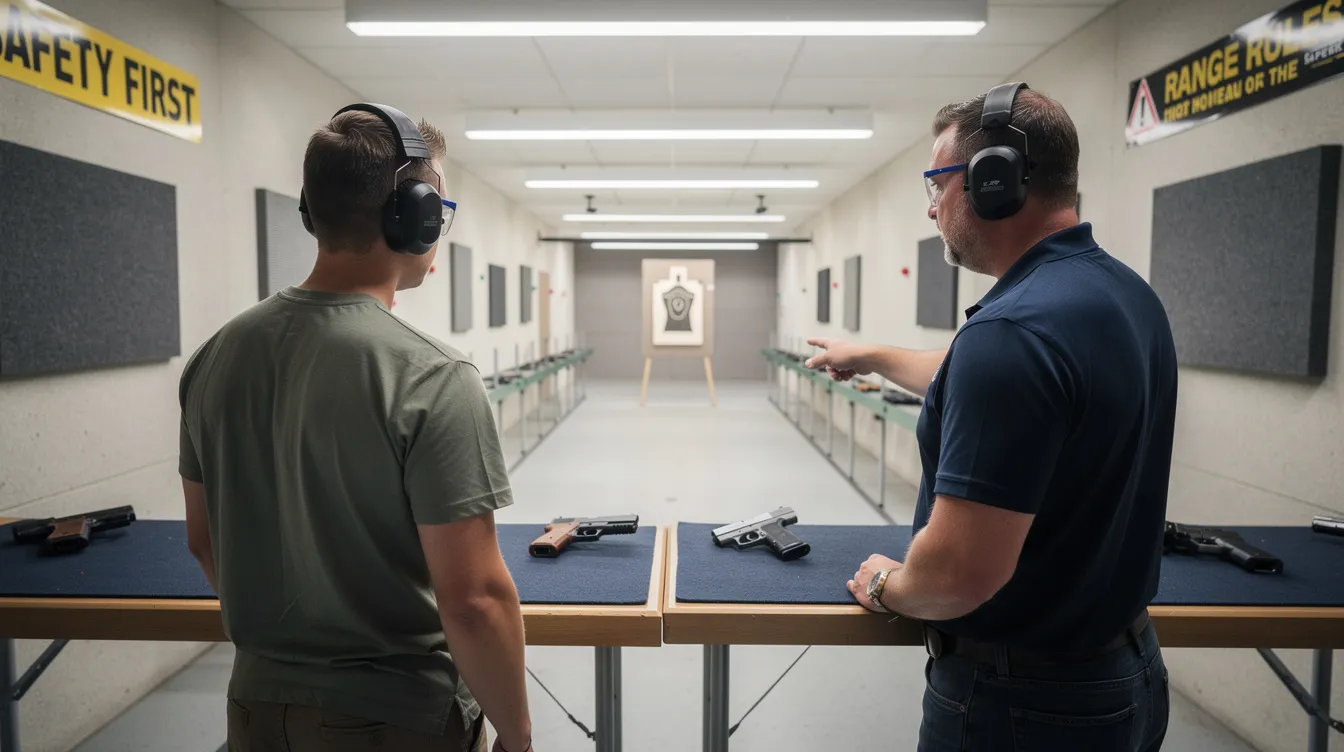
Prospective gun owners must undergo mandatory training in Massachusetts. Applicants must pass a state-approved firearm safety course before a license can be issued. Under the 2024 reforms, the curriculum was updated to cover:
-
Massachusetts firearms laws and legal responsibilities
-
Safe firearm storage practices and suicide prevention
-
Hands-on handling and live fire training (effective April 2, 2026 for new applicants)
A firearm instructor certified under the new standards must deliver the course. For FID applicants, a hunter education certificate may substitute in some circumstances. The live fire training component is now mandatory for all new applications, adding both time and cost but ensuring that every license holder has demonstrated basic proficiency.
Background Checks
Background checks are run through the Massachusetts criminal justice information services (CJIS) system and federal databases. The review covers:
-
Criminal history (felonies, violent misdemeanors, domestic violence offenses)
-
Active restraining orders or harassment prevention orders
-
Mental health disqualifiers (involuntary commitments under M.G.L. c. 123)
-
Substance abuse records and drug-related convictions
-
Fugitive status, military discharge records, and other red flags
Licensing requires training, background checks, and an interview in Massachusetts – there are no shortcuts. The licensing authority must act within 40 days of receiving a completed application. If denied, applicants receive written reasons and may appeal through the district court system.
Keep in mind that renewal notices must be sent at least 90 days before your license expires. If you move, report your new address through the MIRCS portal within 30 days.
Assault Weapons, Large-Capacity Firearms, and Machine Guns
Massachusetts has one of the strongest gun laws frameworks in the country when it comes to prohibited weapons. The state adopted the federal 1994 Assault Weapons Ban language and maintained those restrictions even after the federal ban expired in 2004. The 2024 law further refined these definitions.
Assault-Style Firearms
The 2024 law replaced the term “assault weapon” with “assault-style firearm” and introduced updated feature-based tests. Under state law, a semiautomatic rifle with a detachable magazine plus at least two of the following features qualifies as banned:
-
Folding or telescoping stock
-
Thumbhole stock or pistol grip
-
Forward grip or protruding non-trigger-hand grip
-
Threaded barrel capable of accepting a flash suppressor or silencer
-
Barrel shroud
Similar feature tests apply to semiautomatic pistols and semiautomatic shotguns (each requiring two qualifying features from their respective lists). Massachusetts prohibits certain firearms deemed as assault weapons. Assault weapons include all models of AK-47 and Uzi, among other specifically named platforms. Post-September 13, 1994 assault weapons are generally prohibited to possess, sell, or transfer in the Commonwealth.
Massachusetts law also bans revolving cylinder shotguns like the Street Sweeper, which the legislature categorized alongside other prohibited configurations due to their lack of lawful purposes for sporting or self-defense use.
Large Capacity Firearms and Feeding Devices
A large capacity firearm or large capacity weapon is any firearm that accepts a large capacity feeding device – generally defined as:
|
Type |
Capacity Threshold |
|---|---|
|
Handguns and rifles |
More than 10 rounds |
|
Shotguns |
More than 5 shells |
Magazines holding more than 10 rounds are prohibited for handguns and rifles in Massachusetts, with a narrow exception for devices lawfully possessed before the September 13, 1994 cutoff (so-called “pre-ban” devices). Large capacity rifles and shotguns require an LTC for lawful possession. Anyone possessing a large capacity feeding device must be able to demonstrate its pre-ban status if challenged.
Approved Handgun Roster
Only handguns on the approved roster can be sold in Massachusetts. The attorney general maintains this roster, and handguns not on the approved roster cannot be sold in Massachusetts by licensed dealers. This applies to new retail sales; private transfers of non-roster handguns between individuals who already lawfully possess them may still occur under specific conditions.
Machine Guns
Machine gun possession without the narrow legal exemptions described earlier is a felony under Chapter 269, carrying severe penalties including mandatory state prison time. The definition covers any firearm capable of automatically discharging multiple shots per trigger pull, whether originally manufactured that way or modified with automatic component parts. The revolving cylinder mechanism on certain prohibited shotguns also falls into related restricted categories.
Licensed dealers and private sellers must comply with all assault weapons restrictions. Violations result in serious criminal penalties, forfeiture of the firearm, and potential loss of all firearms rights.

Firearm Storage, Transport, and Theft Prevention
Massachusetts firearm storage and transport rules are central to the state’s public safety strategy. Violations can lead to criminal charges even if no one is injured, and unsecured firearms may be confiscated by law enforcement.
Storage Requirements
Under M.G.L. § 140-131L, firearms must be stored in a locked container when not in use. Specifically:
-
Firearms in the home must be stored unloaded
-
They must be kept in a locked container, a secure container, or secured with a state-approved safety device or other safety device (such as a trigger lock or cable lock) when not under the owner’s immediate control
-
A locked trunk, locked case, or other secure container all satisfy the requirement
-
Storage facilities should prevent access by any person who is not a lawfully authorized user or other lawfully authorized user of the firearm
Failure to comply with safe storage can result in criminal liability, especially if an unauthorized person – including a child – gains access to an improperly stored firearm.
Vehicle Transport
Transporting firearms requires them to be unloaded and locked. The rules break down as follows:
|
Scenario |
Requirement |
|---|---|
|
Handguns |
Unloaded, in a locked case or locked trunk |
|
Rifles and shotguns |
Unloaded, in a locked case or locked trunk |
|
Large capacity firearms |
Unloaded, in a locked case or locked container – trigger locks alone do not meet transport requirements |
|
Ammunition |
May be stored separately; no specific container requirement but best practice is separate locked storage |
Trigger locks do not meet Massachusetts transport requirements on their own. Always use a locked case, locked trunk, or other secure container. Barrel length and overall firearm configuration do not change these requirements – the rules apply uniformly.
Theft Prevention Best Practices
Beyond the legal minimums, firearm owners should consider:
-
Using heavy, fire-rated safes bolted to the floor
-
Storing ammunition separately from firearms
-
Installing alarm systems and security cameras in storage areas
-
Avoiding leaving firearms in unattended vehicles whenever possible
Reporting Obligations
State law requires gun owners to report lost or stolen firearms to local police and the criminal justice information services within seven days of discovery. Firearm owners must also report sales or transfers within seven days through the MIRCS Gun Transaction Portal. Failure to report can result in fines, license suspension, and potential criminal charges. Each firearm should have its serial number recorded and kept in a safe place for reference.
Reducing Gun Violence and Suicide Prevention Measures
Massachusetts firearms laws are designed not only for crime control but also for broader gun violence reduction, including suicide prevention and domestic violence protections. The state’s approach combines enforcement mechanisms with community-based interventions.
Universal Background Checks
All firearm sales and transfers – including most private sales – must be processed through the Massachusetts Gun Transaction Portal, ensuring that background checks screen every prospective buyer. This system aims to prevent prohibited persons from acquiring firearms and creates a paper trail for law enforcement tracing.
Extreme Risk Protection Orders
Massachusetts has a red flag law enacted in 2018, which was further enhanced by the 2024 reforms. The extreme risk protection order statute allows temporary removal of firearms from dangerous individuals when a court finds they pose a significant risk to themselves or others. Eligible petitioners may include:
-
Law enforcement officers
-
Family or household members
-
Medical professionals (under certain conditions)
ERPOs can last up to one year and may be renewed. During the order’s duration, the subject must surrender all firearms to law enforcement or a licensed dealer and cannot purchase firearms or ammunition.
Suicide Prevention
Firearm access significantly increases suicide lethality. Massachusetts addresses this through multiple channels:
-
Licensing cards now display contact information for the 988 Suicide and Crisis Lifeline
-
The mandatory safety course curriculum includes modules on recognizing warning signs of self-harm
-
Gun owners are encouraged to use temporary off-site storage with a trusted individual or licensed dealer during personal or family crises
-
Voluntary surrender programs at local police stations allow firearm owners to temporarily relinquish weapons without fear injury to their licensing status
-
The executive office of public safety and security coordinates public education campaigns with community organizations
Partnerships with mental health hotlines and organizations like the commonwealth second amendment advocacy groups, the gun owners action league, and the national rifle association’s safety programs encourage responsible firearm ownership alongside crisis awareness.

Penalties for Violations and Legal Considerations
Penalties for violating Massachusetts gun laws can be severe. The state treats firearms offenses seriously, and even technical violations can carry lasting consequences for gun owners.
Common Criminal Offenses
|
Offense |
Potential Penalty |
|---|---|
|
Carrying a firearm without a Massachusetts-issued license (a felony) |
Mandatory minimum imprisonment, fines, permanent firearms disqualification |
|
Unlawful possession of assault weapons or prohibited large capacity magazines |
Felony charges, firearm forfeiture, prison time |
|
Improper firearm storage leading to unauthorized access |
Criminal charges, license revocation, civil action liability |
|
Failure to report stolen firearm within seven days |
Fines, license suspension |
|
Possessing a machine gun without proper license |
Felony under Chapter 269, mandatory state prison |
Some crimes under M.G.L. c. 269 carry mandatory minimum prison terms, especially when firearms are possessed during violent or drug-related offenses. A civil action may also be brought by victims harmed as a result of negligent storage or illegal possession.
Technical Violations
Even seemingly minor infractions carry real risk:
-
Failing to renew a license before expiration can render you an unlicensed possessor
-
Not reporting a change of address within 30 days may lead to license suspension
-
Violating restrictions imposed on an LTC (such as carrying outside the scope of a “Target & Hunting” restriction) can result in revocation
-
The boston police commissioner and other local authorities actively enforce compliance within their jurisdictions
Important Disclaimer
This guide is for general informational purposes only and does not constitute legal advice. Massachusetts firearms laws change frequently through legislation, court decisions, and regulatory updates. Always consult a qualified attorney or your licensing authority for case-specific guidance.
Frequently Asked Questions
How do Massachusetts gun laws compare to those in other states?
Massachusetts consistently ranks among the states with the strongest gun laws and lowest gun deaths per capita. The state features universal background checks for virtually all sales, mandatory licensing with training requirements, a comprehensive assault weapons ban, and strict storage mandates. By comparison, many other states lack universal background check requirements or do not require any license for firearm ownership. The combination of licensing rigor, prohibited weapons lists, and enforcement mechanisms places Massachusetts alongside California, New York, and Connecticut at the restrictive end of the national spectrum.
Can I bring my lawfully owned firearm from another state into Massachusetts?
Massachusetts does not honor concealed carry permits from other states. Non residents generally must obtain a temporary non-resident LTC from the state police before carrying any firearm in the Commonwealth. Even with a valid temporary license, certain firearms – including many assault weapons, large capacity feeding devices manufactured after September 1994, and handguns not on the approved roster – remain illegal to possess in Massachusetts regardless of their legality in your home state. Before traveling with any firearm, verify that each specific weapon and magazine complies with massachusetts law.
Are there special rules for new residents moving to Massachusetts with firearms?
New residents must comply with Massachusetts firearms laws shortly after establishing residency. This means:
-
Applying for an FID or LTC through your local police department
-
Ensuring every firearm you possess is lawful under state assault weapons and capacity rules
-
Registering any privately made firearms (ghost guns) through the MIRCS portal and ensuring they have a serial number
-
Completing the required safety training course
-
Reporting any transfers or acquisitions through the Gun Transaction Portal
If any of your firearms qualify as prohibited assault weapons or use post-ban large capacity feeding devices, you cannot legally possess them in Massachusetts, even if they were lawful in your previous state.
Can I keep a gun in my home for self-defense without a License to Carry?
A valid FID or LTC is still required to lawfully possess most firearms in the home. An FID covers non-large-capacity rifles and shotguns. If you want to keep a handgun or any large capacity firearm for home defense, you need an LTC – even if the firearm never leaves your house. There is no “home defense exemption” from the licensing requirement under massachusetts law. The firearm must also be stored in a locked container or secured with an approved other safety device when not under your immediate control.
Where can I find official updates on Massachusetts firearm laws and regulations?
The most reliable sources include:
-
The Massachusetts Executive Office of Public Safety and Security firearms pages
-
The Firearms Records Bureau within the state police
-
The Massachusetts General Court’s online statutes for the full text of Chapter 140 and Chapter 269
-
Your local police department’s website for municipality-specific licensing policies and announcements
-
The attorney general’s office for guidance on assault weapons definitions and the approved handgun roster
Laws continue to evolve. Ballot initiatives seeking to modify parts of the 2024 reforms remain possible, and court challenges to specific provisions are ongoing. Checking these sources periodically – or working with a firearms attorney – is the most reliable way to stay compliant as a responsible firearm owner in the Bay State.
Meta tags
title
Understanding Massachusetts Gun Laws: Essential Rules and Regulations
0/70
description
Navigate Massachusetts gun laws with confidence. Learn essential rules and regulations to stay informed and compliant. Read the article for clarity.
0/156