California Gun Laws: 2026 Guide for Residents, Owners, and Industry
California has some of the most detailed gun laws in the country. This guide explains the major 2026 rules for buyers, owners, new residents, and firearm industry members in plain English, while noting where litigation and new laws may change the answer quickly.
Key Takeaways
Under california law, a prohibited person may not buy, receive, own, or possess firearms or ammunition; this includes many felony convictions, certain misdemeanor offenses, restraining orders, and mental health prohibitions.
Most firearm sales and firearm transfers must go through a licensed dealer, with a DROS submission, background check, and 10-day waiting period before delivery.
The old one-gun-per-30-days limit was struck down in Nguyen v. Bonta, and California’s 2026 replacement allows up to three firearm purchase applications in a rolling 30-day period.
assault weapons, .50 BMG rifles, short barreled shotguns, and large-capacity magazines remain heavily restricted, even while cases continue in federal district court and the ninth circuit court.
The california doj Bureau of Firearms is the central authority for background checks, firearm registration reports, the Roster of Handguns Certified for Sale, and many compliance forms.
This article is an educational overview of California firearms laws only. It is not personal legal advice.
Understanding California’s Gun Law Framework
California firearms laws are built from several layers: state law, federal law, DOJ regulations, and local ordinances in cities such as san francisco, Los Angeles, and San Diego. That is why a california citizen can be legal under federal firearms laws but still violate a penal code section in California.
The main statutes are in the penal code, especially Part 6 on control of deadly weapons. Mental health restrictions also appear in the welfare and institutions code, including sections tied to involuntary holds and firearm prohibitions. Civil Code provisions now matter too, especially for firearm industry members facing civil liability over sales practices, parts, digital files, and unsafe distribution.
The california department of Justice, through the Bureau of Firearms, administers the DROS system, publishes forms such as BOF 116 and BOF 4010A, maintains the roster of handguns certified for sale, and regulates firearms dealers. You can start with the official California DOJ firearms information page for current forms and notices.
The U.S. supreme court changed the legal landscape in New York State Rifle & Pistol Association v. Bruen in 2022. After that pistol association case, California moved away from “good cause” requirements for concealed carry, but it still requires background screening, training, live-fire qualification, and “good moral character.”
The practical rule: always check the current statute, DOJ bulletin, and court status before relying on what you read last year.
Who May Possess Firearms in California?
California defines prohibited persons more broadly than many people expect. Under Penal Code §§ 29800–29825 and related statutes, a person may be barred from possessing firearms because of felony convictions, certain violent misdemeanors, domestic violence restraining orders, juvenile court findings, or mental health events under the welfare and institutions code.
Common California prohibitions include:
Felony convictions and certain violent crimes.
Domestic violence convictions and restraining orders.
Certain mental health commitments, including some Welf. & Inst. Code § 5150 situations.
New 10-year bans for specified misdemeanor offenses effective January 1, 2026.
Certain firearm-specific crimes involving ghost guns, assault weapons, zip guns, short barreled shotguns, and illegal manufacturing.
California’s age rules are also strict. Generally, handgun purchases require the buyer to be 21. Most semiautomatic centerfire rifle purchases also require age 21. Some 18-to-20-year-olds may purchase certain non-semiautomatic rifles or shotguns if they have a valid hunting license.
Minors face separate limits. They generally may not possess handguns except under narrow supervised circumstances, such as hunting, sport, agricultural activity, or practicing shooting with a parent, legal guardian, or qualified adult. California also restricts when minors may possess live ammunition or unexpended ammunition.
Examples help:
A person convicted in 2026 of misdemeanor possession of an assault weapon under Penal Code § 30605 may face a 10-year ban on firearm ownership and ammunition.
A person placed on a qualifying mental health hold may temporarily or longer-term lose gun rights, depending on the record and hearing outcome.
law enforcement officers, police officers, a peace officer acting within authorized duties, active armed forces members, and certain other exempt groups may have different rules. But those exemptions are narrow and do not apply to ordinary law abiding citizens.
How to Check If You Are Eligible (California DOJ Eligibility Check)
If you are unsure whether you can legally own or buy a firearm, California offers the Personal Firearms Eligibility Check, or PFEC. This is run by the california doj under Penal Code § 30105.
Here is how it works:
Download BOF 116 from the DOJ PFEC page.
Complete the form with identifying information.
Include a copy of your California driver license or california identification card.
Provide the required thumbprint and notarized signature.
Pay the current fee, listed by DOJ as $20 in recent instructions.
Mail the application as directed by DOJ.
PFEC checks California criminal and mental health records. It does not run a full federal NICS check. That means a PFEC result is useful, but it does not guarantee that a future gun purchase will be approved under federal law or federal firearms laws.
Processing can take around 60 days, and DOJ instructions warn that some applications may take longer. Your result can also change if you are later arrested, convicted, placed under a restraining order, or otherwise become a prohibited person.
Firearm Sales, Purchases, and Transfers
In California, almost every california gun sale must go through a licensed firearms dealer. The dealer usually must have a Federal Firearms License, California licensing, and often a Certificate of Eligibility.
The standard process is called DROS, or Dealer Record of Sale:
Step | What happens |
|---|---|
Buyer chooses firearm | Must be legal in California and, for most dealer handgun sales, on the roster |
Dealer submits DROS | Buyer identity, residency, and firearm information go to DOJ |
Background check | DOJ reviews eligibility records |
Waiting period | Buyer waits 10 calendar days |
Delivery | Dealer releases the firearm only if approved |
The 10-day waiting period applies to handguns and long guns. The clock starts when DROS is submitted, not when you first walk into the store.
Buyers generally need proof of California residency, such as a valid California driver license or ID. Some handgun purchases require additional proof of address. Most buyers also need a firearms safety certificate. Older references may mention a valid handgun safety certificate or handgun safety certificate, but California now generally uses the Firearm Safety Certificate system.
As of June 6, 2026, the old one-gun-per-30-days law has been replaced after Nguyen v. Bonta. California’s newer framework allows up to three firearm purchase applications in a rolling 30-day period, subject to exemptions and DOJ implementation. This applies more broadly than the old handgun-focused rule.
private party transfers must also go through a licensed dealer. Both parties appear at the dealer, complete paperwork, leave the gun during the waiting period, and pay state-regulated fees. The dealer cannot simply sell firearms or transfer firearms outside this system unless a specific exemption applies.
Ammunition sales have their own rules. California has required an ammunition purchase background check at the point of sale, although Rhode v. Bonta and related litigation have challenged that system. Until DOJ guidance or final court orders clearly change the process, buyers and sellers should follow current DOJ instructions.
Intra-Familial and Inheritance Transfers
California treats some family transfers differently, but “family” is narrower than many people think. Qualifying immediate family members usually include parent-child and grandparent-grandchild transfers. A sibling, cousin, uncle, friend, or unrelated family member generally does not qualify for the same exemption.
For qualifying in-state intra-familial transfers, the recipient usually must:
Be legally eligible to own firearms.
Have a firearms safety certificate unless exempt.
Report the transfer to DOJ within the required period, commonly 30 days.
Ensure the firearm itself is legal in California.
Inheritance from out of state is more complicated. california residents may generally inherit a lawful handgun or other firearm from an out of state parent or grandparent, but the gun must be legal in California and the transfer often must go through a California FFL.
Example: inheriting a standard 1911 pistol from an Arizona parent may be possible if the California heir is eligible and the transfer is processed correctly. Trying to inherit an AR-15 that meets California’s definition of an assault weapon is very different. The heir usually cannot bring it into California unless a rare exemption applies.
Large-capacity magazines, unregistered assault weapons, .50 BMG rifles, and illegal configurations cannot be made lawful just because they came from an estate.
Assault Weapons, “Bullet Buttons,” and the Assault Weapons Control Act
California’s assault weapon rules began with the Roberti-Roos Assault Weapons Control Act of 1989 and were expanded many times. The law bans specific makes and models, including many AR- and AK-style firearms, and also bans semiautomatic firearms with prohibited feature combinations.
California uses two major classification methods:
Named models, including the Kasler list.
Feature-based definitions for rifles, pistols, and shotguns.
Features can include pistol grips, flash suppressors, folding or telescoping stocks, and certain magazine configurations. A firearm capable of accepting a detachable magazine plus prohibited features may become an assault weapon under California law.
“Bullet button” rifles are a major historical example. For years, some owners used bullet buttons to argue a rifle had a fixed magazine. California later redefined “fixed magazine,” closing that path. Many bullet-button rifles had to be registered during a past window or reconfigured.
New assault weapon registrations are generally closed. Possession is usually illegal unless the firearm was registered during a valid period, the owner has a Dangerous Weapon Permit, or a narrow exemption applies for certain law enforcement agency uses, research, or official purposes.
Cases before Judge Roger Benitez and appeals in the ninth circuit court have challenged California’s assault weapon laws. Some district court rulings have favored challengers, but stays often keep the laws enforceable. Check the latest orders before making decisions.
High-level compliant alternatives may include featureless rifles or true fixed-magazine builds, but owners should avoid home “workarounds” without legal review.
Handgun Roster and Approved Firearms
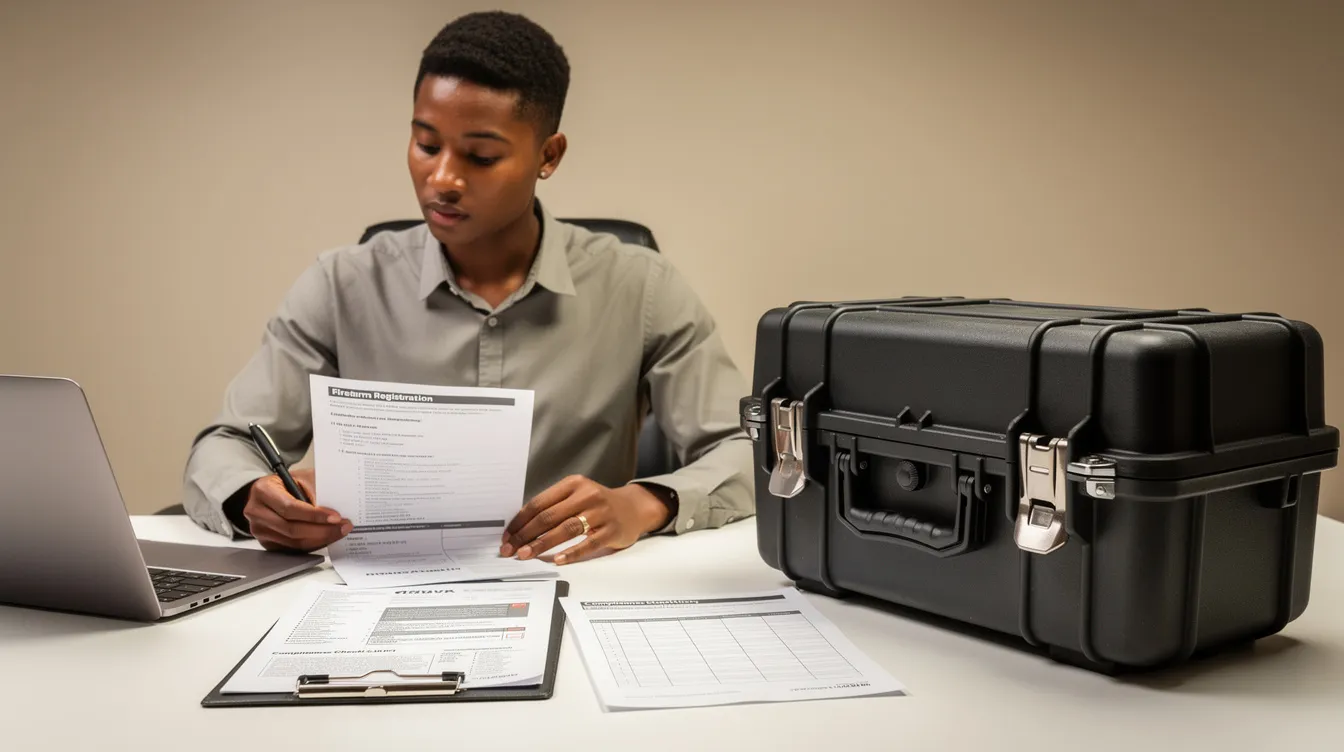
California’s Roster of Handguns Certified for Sale limits what firearms dealers may sell to the general public. With exceptions, a new dealer-sold handgun must appear on the roster.
The roster system has required drop testing, firing testing, and other safety features. Historically, microstamping requirements limited many new semiautomatic pistols from entering the California market.
Major roster exemptions include:
private party transfers.
Certain intra-familial transfers.
Some curios and relics.
Certain single-action revolvers.
Pawn returns.
Some law enforcement off-roster purchases.
The roster has been heavily litigated. Challenges to microstamping and other requirements have produced federal district court activity and appeals. As of 2026, buyers should check the live DOJ roster before placing a deposit or starting DROS.
A simple habit helps: search the exact make, model, barrel length, and finish on DOJ’s roster before visiting a dealer.
Concealed Carry, Open Carry, and Transporting Firearms
California generally prohibits concealed carry in public without a valid CCW license issued by a county sheriff or municipal police chief. After Bruen, California no longer requires “good cause” in the old sense, but the process is still restrictive.
Applicants usually face:
A background check.
Training and live-fire qualification.
Local interviews.
“Good moral character” review.
Restrictions on listed firearms.
Open carry is also heavily restricted. California generally bans open carry of a loaded firearm or unloaded firearm in incorporated areas and most public places. Narrow exceptions may apply on private property, in some rural areas, during hunting, or for authorized activities.
Transport rules are different from carry rules. A handgun in motor vehicles generally must be unloaded and in a locked container or locked trunk unless the person has a valid CCW or another exemption. A glove box or center console usually is not enough. Long guns should be unloaded and may need to be locked in certain places, including school zones.
Sensitive places can remain off-limits even with a permit. These may include school grounds, courthouses, secured airport areas, and certain government buildings.
Example: taking a pistol to a range in Los Angeles County is usually lawful if it is unloaded, locked, and transported directly. Carrying that same pistol in a backpack while shopping without a CCW can be a crime.
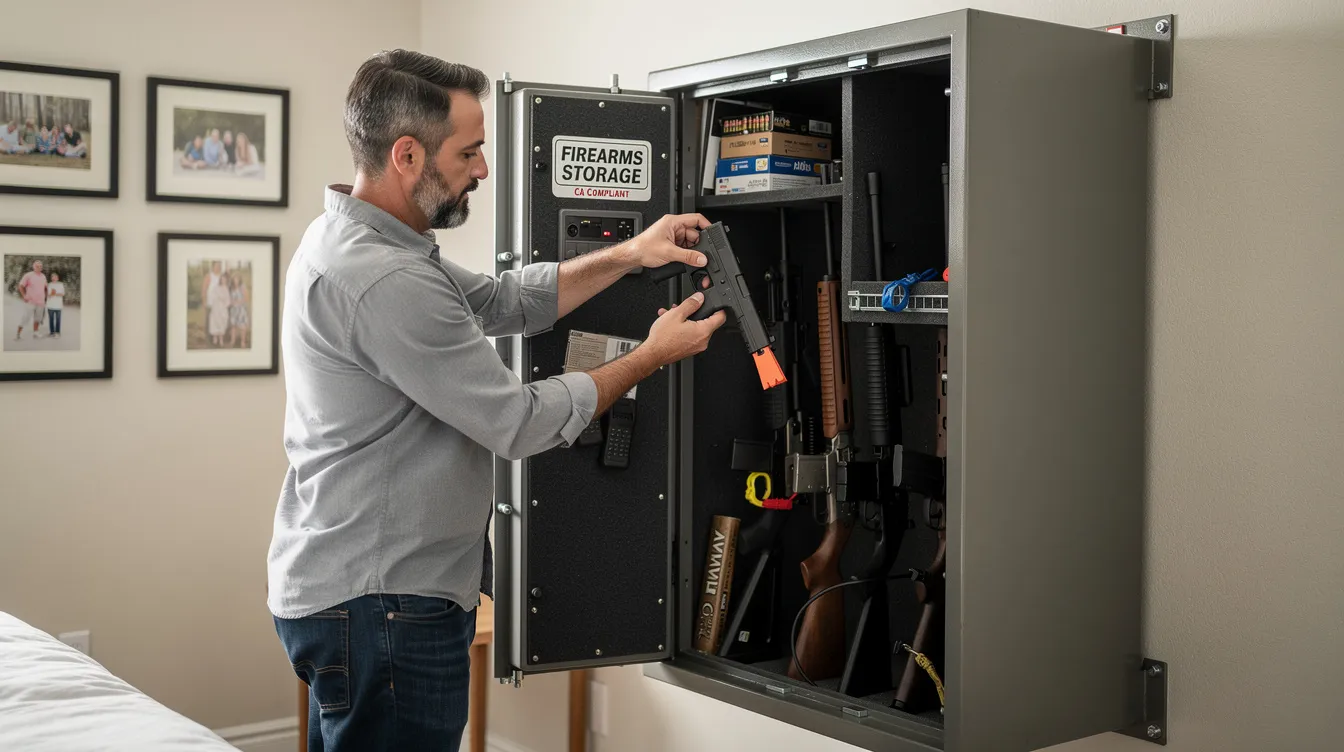
Storage, Safe Handling, and Criminal Liability
California’s criminal storage laws focus on preventing children and prohibited persons from gaining access to firearms. If a child or prohibited person can gain access and harm results, the owner may face criminal storage charges.
To reduce risk, store firearms:
In a locked container.
In a safe.
With a DOJ-approved locking device.
Separate from ammunition when practical.
At sale, dealers must provide or verify a DOJ-approved lock or safe. Local ordinances may add stricter storage rules, especially in dense housing or cities with additional safety laws.
Other crimes can arise from unsafe handling. Brandishing in a rude or threatening manner, negligent discharge, shooting at buildings or vehicles, and carrying loaded guns in prohibited places can all trigger arrest. Self defense may justify some uses of force, but it is not a blanket excuse.
Practical habits matter:
Record serial numbers.
Keep DROS paperwork and DOJ confirmations.
Photograph firearms for insurance records.
Anchor safes when possible.
Review lease, landlord, and insurer requirements.
California law may create a legal presumption in some storage-related cases depending on access, custody, and circumstances.
New California Gun Laws and Trends for 2025–2026
The california legislature changes gun laws almost every year. For 2025–2026, several changes matter.
First, California expanded 10-year firearm and ammunition prohibitions tied to misdemeanor offenses. Beginning January 1, 2026, convictions for certain crimes involving undetectable firearms, unserialized firearms, unlawful manufacturing machines, assault weapons, .50 BMG rifles, multi-burst trigger activators, zip guns, and short-barreled firearms can trigger long bans.
Second, California continues to target unlawful firearm manufacturing. Penal Code § 29186 created penalties for aiding or facilitating unlawful firearm manufacturing, and related Civil Code provisions expand civil liability.
Third, digital firearm files are now a major enforcement focus. CAD, CAM, 3D-printing, and CNC milling code can create liability if distributed in ways that contribute to unlawful firearm production or harm.
Fourth, firearm industry members selling precursor parts or ghost-gun components face stricter disclosures, age verification, shipping limits, and warnings. This includes obligations around components that may become frames, receivers, or other firearm parts.
Finally, cases involving ammunition background checks, large-capacity magazines, and assault weapons remain active. Monitor DOJ notices and federal court orders, especially from the ninth circuit court and supreme court.
Requirements for New California Residents and Nonresidents
New residents bringing firearms into California generally must report them within 60 days using the New Resident Firearm Ownership Report, BOF 4010A, and pay the current fee, recently listed as $19 per person. The alternative is usually to sell or transfer the firearms lawfully.
Imported firearms must be California-legal. That means no banned assault weapon configurations, no .50 BMG rifles, no illegal short-barreled rifles or shotguns, and no magazines over the lawful capacity limit unless a valid exemption applies.
Nonresidents passing through California may have federal protection under the Firearm Owners’ Protection Act, but only if conditions are met. Firearms should be unloaded, locked, inaccessible, and the travel should be continuous with no unnecessary stops.
There are limited allowances for nonresidents attending organized competitions involving assault weapons or .50 BMG rifles, but the event must meet statutory requirements and usually be held at an authorized range or by a qualifying public or private club.
Travelers should be cautious. Local enforcement may not interpret FOPA or competition exemptions the same way in every county.
Firearm Industry Members: Compliance and Liability
California imposes a Firearm Industry Standard of Conduct on dealers, manufacturers, distributors, and related businesses. This affects companies operating in California and online retailers shipping into the state.
Compliance duties include:
Detailed records.
Reporting lost or stolen firearms.
Age verification.
Advertising and sales restrictions.
DOJ-compliant warnings for certain parts.
Restrictions on precursor parts and manufacturing tools.
Recent laws expanded civil liability, allowing the state and private plaintiffs to sue firearm industry members for violations. Claims may involve ghost-gun parts, digital code, unsafe distribution, or failure to prevent illegal use.
FFLs, gunsmiths, and online sellers should review DOJ guidance often. Annual compliance audits are no longer optional for serious businesses. They are practical risk management.
Practical Tips for California Gun Owners and Prospective Buyers
Before buying, transferring, carrying, or modifying a firearm, use a simple checklist.
Confirm you are not a prohibited person.
Review DOJ FAQs and county rules.
Check the handgun roster.
Keep DROS and firearm registration records.
Track serial numbers, purchase dates, and transfer forms.
Use safe storage every day, not only when children visit.
Take training from a doj certified instructor when required or useful.
Stay current on ammunition, magazine, and assault weapon litigation.
law abiding gun owners can still face serious charges for paperwork mistakes, illegal configurations, or misunderstanding transport rules. California gun ownership rewards careful documentation and regular self-education.
Frequently Asked Questions
Can I inherit a firearm from a family member who lived in another state?
Yes, California residents may generally inherit firearms from out-of-state family members if the firearm is legal under California law and the recipient is eligible. The transfer usually goes through a California FFL, followed by DROS, the 10-day wait, and a background check.
AR-15 or AK-style rifles, large-capacity magazines, .50 BMG rifles, and illegal configurations may not be transferable into California.
Are large-capacity magazines legal in California right now?
California generally bans manufacturing, importing, selling, or transferring magazines that hold more than 10 rounds. Litigation such as Duncan v. Bonta has created changing rulings and stays, but owners should verify the latest court orders and DOJ guidance before relying on any advice.
Do I need a background check to buy ammunition in California?
California has required DOJ eligibility checks for most ammunition purchases. The system has been challenged in Rhode v. Bonta, and court rulings may affect enforcement. Until a final order and DOJ guidance clearly change the process, buyers should expect dealers to run an electronic check before releasing ammunition.
Can I carry a handgun in my car without a CCW if it is unloaded?
For most people, a handgun in a vehicle must be unloaded and locked in a secure container or locked trunk. A glove box or center console usually is not enough. Ammunition should be stored separately when possible.
A valid CCW gives more flexibility, but sensitive-place rules and local restrictions still apply.
What happens if I move out of California with my registered firearms?
If you permanently move out of California, you generally follow the laws of your new state once you arrive. You still need to comply with California transport rules while leaving and with the laws of states you cross.
California usually does not require notice that the firearms were removed, but historical records may remain in DOJ databases.
What is the minimum age to purchase semiautomatic rifles in California?
As of January 1, 2020, the minimum age to purchase semiautomatic rifles in California is 21 years old. This aligns with the age requirements for most other firearms in the state.
How many active concealed carry permits were there in California as of 2011?
As of September 2011, California had approximately 35,000 active concealed carry permits issued across the state.
Does California recognize concealed carry permits from other states?
No, California does not recognize concealed carry permits issued by other states. Residents and visitors must comply with California’s own licensing requirements to carry concealed firearms legally.
What are the penalties for carrying a concealed firearm without a permit in California?
Carrying a concealed firearm without a valid permit in California is classified as a misdemeanor. Penalties can include jail time and fines.
Are firearm transfers to immediate family members subject to dealer requirements in California?
Transfers of firearms to immediate family members are generally exempt from the requirement to conduct the transfer through a licensed dealer. Immediate family members typically include parents, children, grandparents, and grandchildren.
Must new semiautomatic rifles be registered in California?
Yes, as of January 1, 2017, all new semiautomatic rifles sold or transferred in California must be registered with the California Department of Justice.
Is it legal to obliterate firearm identification marks in California?
No, obliterating or altering firearm identification marks such as serial numbers is illegal in California and subject to criminal penalties.
Is a Safe Handling Demonstration required to purchase a firearm in California?
Yes, California requires purchasers of firearms to perform a Safe Handling Demonstration, which involves showing the ability to safely handle the firearm before taking possession.
Meta tags
title
Understanding California Gun Laws: Key Regulations and Requirements
67/70
description
Explore essential California gun laws, including key regulations and requirements. Stay informed and compliant—read the article for critical insights.
150/156